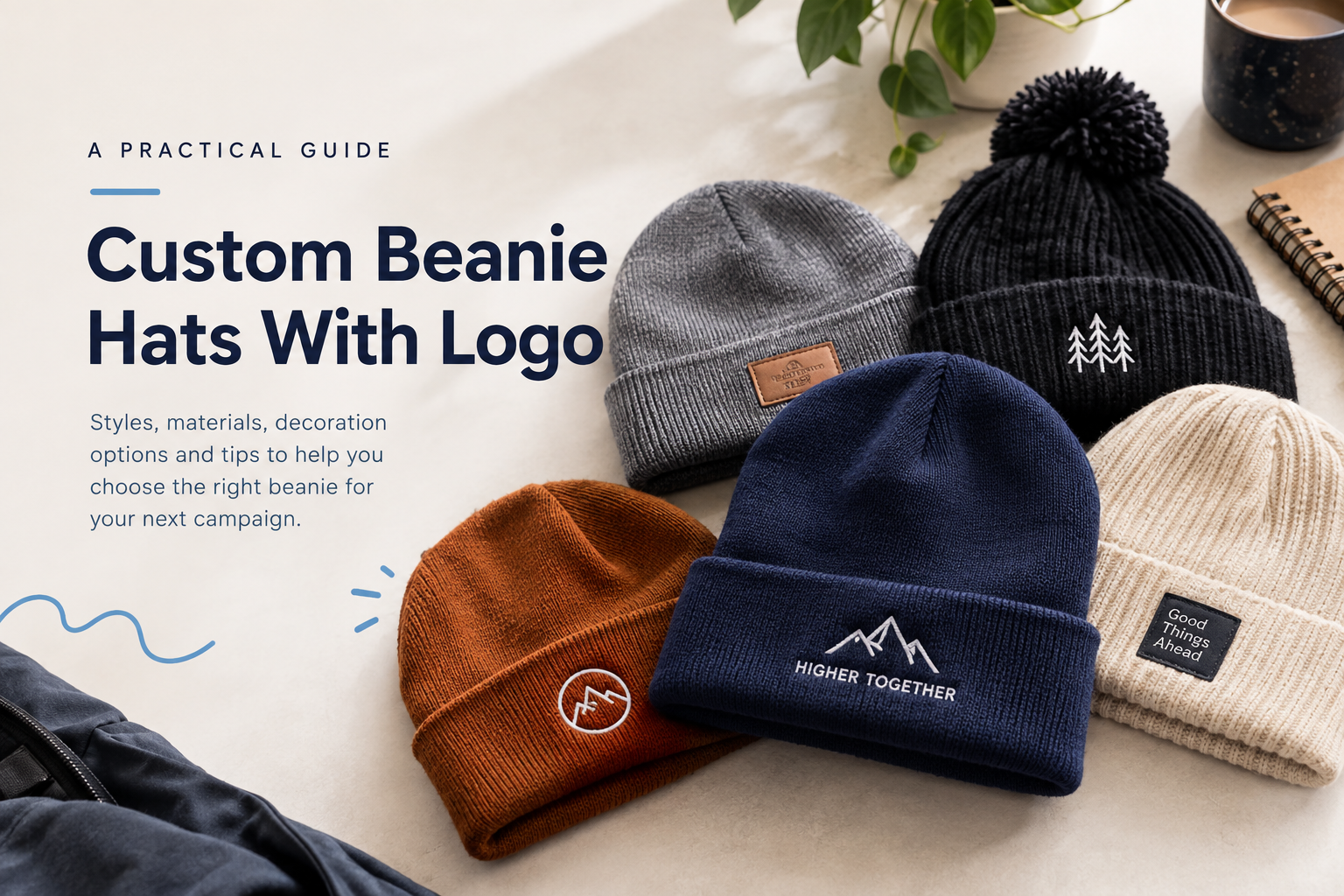
Custom Beanie Hats With Logo: What to Know Before You Order
A good promotional beanie should feel like something someone would choose to wear anyway. The logo comes second. Browse knit beanies with your logo or the wider hats and headwear range once you know the style.
That is especially true with winter headwear. People care about warmth, comfort, fit, color, and how the hat looks with the rest of their clothes. If those things are right, your branding gets seen naturally when the beanie leaves the office, event, jobsite, or store.
If you are comparing different types of branded headwear, Trendy Promo’s custom hats and caps with logo guide covers baseball caps, dad hats, trucker hats, performance caps, and beanies. For a winter-focused campaign, though, a beanie deserves its own approach.
Why Custom Beanies Make Sense for Promotional Campaigns
Beanies work particularly well when the recipient is likely to use them in the environment where the brand wants to be remembered.
Think about:
Employee winter gifts
Outdoor and field teams
Construction and service crews
Ski and winter sports events
Holiday promotions
College and community events
Retail merchandise
Customer appreciation gifts
Company stores
New employee welcome kits
They can also make sense for brands that want promotional merchandise to feel less like advertising. A simple knit hat with a small embroidered logo can look much closer to retail merchandise than a traditional giveaway.
That is why it is worth choosing the beanie based on the person wearing it, not just the logo going on it.
How to Choose the Right Custom Beanie
There is no single “best” beanie for every campaign. Start with four questions:
Who is receiving it?
Where will they wear it?
How cold is the environment?
Do you want the finished product to feel promotional or retail-inspired?
A warehouse crew may need a warm, practical cuffed beanie. A tech company’s employee gift might call for a cleaner, understated style. A college event could have more room for a bold color or pom-pom design.
If you are shopping across multiple apparel categories, Trendy Promo’s custom apparel and wearables collection is a useful place to compare beanies with caps, jackets, hoodies, polos, and other branded apparel.
Popular Beanie Styles for Branding
Cuffed Beanies
The classic cuffed beanie is one of the easiest choices for promotional use.
The folded cuff gives you a defined area for a logo, name, or simple graphic. It also creates the familiar winter-hat look most people already know.
Choose this style for employee gifts, outdoor teams, events, and general winter promotions.
Cuffless Beanies
Cuffless styles have a more relaxed look and can work well for lifestyle-focused brands.
They are useful when you want the product to feel casual rather than uniform-like. The tradeoff is that your decoration area may be different from what you get on a traditional folded cuff, so check the actual product specifications before approving artwork.
Slouch Beanies
Slouch beanies have extra fabric toward the back and a more fashion-oriented silhouette.
They can be a good fit for younger audiences, creative companies, retail brands, and merchandise collections where appearance matters as much as warmth.
Pom-Pom Beanies
A pom-pom adds a playful seasonal feel.
They can work particularly well for holiday events, winter festivals, schools, sports groups, and family-oriented promotions. They are less appropriate when the goal is a conservative corporate uniform.
Fisherman Beanies
Fisherman-style beanies sit closer to the head and have a shorter profile.
They have become popular in lifestyle and streetwear-inspired merchandise. For a brand that wants something people might keep wearing after the campaign, this style is worth considering.
What Material Should You Choose?
The material affects how the beanie feels, how warm it is, how it looks, and how appropriate it is for the intended use.
Acrylic
Acrylic is common in promotional knitwear because it can provide warmth and softness without the cost or care requirements associated with some natural fibers.
It is a practical option for large employee or event orders.
Wool
Wool can provide a more premium feel and strong warmth.
It is worth considering for higher-end gifts, winter sports programs, or merchandise where the material itself is part of the product experience.
Cotton
Cotton can provide a softer, more familiar feel and may work well for lighter-weight beanies.
It is better suited to situations where extreme cold protection is not the main requirement.
Recycled Materials
Recycled yarn options can be useful when sustainability is an actual part of the brand’s purchasing criteria.
Do not choose a recycled beanie just because the word “eco” sounds good on a product page. Ask what the material is, what percentage is recycled, and what documentation is available.
The product should still make sense for the person receiving it.
Embroidery vs. Other Decoration Options
Beanies have a textured, flexible surface, so decoration needs to be chosen carefully.
Embroidery
Embroidery is one of the most natural choices for beanies.
It gives the logo a stitched, dimensional appearance and works especially well for simple wordmarks, icons, and recognizable brand marks.
It is not ideal for tiny text or highly detailed artwork. Small lettering and thin lines can lose clarity when converted into stitches.
Trendy Promo’s embroidery and decoration guide explains where embroidery works best and where the technique starts to struggle.
Woven Labels and Patches
A woven label or patch can give a beanie a more retail-style finish.
This can be a smart choice for streetwear brands, company merchandise, clubs, and organizations that want the branding to look intentional without putting a large embroidered logo directly onto the knit.
Printed Decoration
Printing can work for certain beanie constructions and materials, but the exact method depends on the product.
Do not assume that the same decoration process used on a T-shirt will produce the same result on a knitted hat. Always check the specific product and decoration specifications.
Keep the Logo Simple
Beanies are not the place to squeeze an entire brand guideline into a tiny space.
A simple logo usually works better than:
A long tagline
Tiny website text
Multiple lines of information
Fine decorative details
Complex gradients
Very thin lettering
If your full logo is too detailed, consider using an icon, shortened wordmark, or simplified version.
For more guidance, Trendy Promo’s promotional product artwork requirements explains vector artwork, embroidery limitations, color matching, imprint size, and what to send with a quote request.
Choosing Beanie Colors
Color can completely change how a branded beanie feels.
Black, navy, charcoal, gray, and neutral tones are easy choices for corporate programs because they tend to work with different outfits.
Brighter colors can make more sense for:
School spirit
Sports teams
Outdoor events
Festivals
Youth-focused brands
Seasonal campaigns
If brand consistency matters, compare the actual available beanie colors against your brand palette rather than assuming a screen image will look identical to the finished knit.
And remember: contrast matters. A dark logo on a dark beanie may technically match the brand colors but still be difficult to see.
Custom Beanies for Different Audiences
Audience | Beanie Style to Consider | Branding Approach |
Employees | Cuffed or clean knit beanie | Small embroidered logo |
Outdoor crews | Warm cuffed beanie | High-contrast logo |
College groups | Cuffed or pom-pom style | Bold school colors |
Retail brands | Fisherman or slouch style | Woven label or subtle embroidery |
Winter events | Classic knit or pom-pom | Event logo or simple mark |
Client gifts | Premium knit style | Small, understated branding |
Sports teams | Team-color beanie | Embroidered logo or patch |
Company stores | Consistent core style | Retail-inspired branding |
The important part is matching the product to the recipient. A beanie that looks great in a product catalog can still be the wrong choice for your audience.
How Many Custom Beanies Should You Order?
Start with the actual distribution plan instead of ordering a random number.
For example, if you have 85 employees, 20 contractors, and 15 extra units for replacements and new hires, a 120-unit order may make more sense than simply ordering 100.
For an event, estimate expected attendance and decide whether every attendee gets one or whether the beanies are reserved for VIPs, staff, speakers, or a giveaway.
Quantity can also affect your unit cost, so it is worth comparing a few order levels before making the final decision.
What Does a Custom Beanie Cost?
There is no single price for a branded beanie.
The final cost can depend on:
Beanie style
Material
Quantity
Brand or blank
Embroidery or decoration method
Number of decoration locations
Stitch count
Patch or label requirements
Setup or digitizing
Packaging
Freight
Delivery destination
The lowest product price is not necessarily the lowest total cost.
When comparing options, look at the complete delivered cost and confirm what is included in the quote.
When Should You Order Promotional Beanies?
Do not wait until the first cold week to start the process.
Production timing depends on the specific product, decoration method, quantity, proof approval, and shipping requirements. If the beanies are needed for a winter event, build enough time into the schedule for artwork review and production.
The easiest way to get an accurate timeline is to provide the quantity, delivery ZIP code, product preference, and required in-hands date when requesting a quote.
Common Custom Beanie Mistakes
Choosing Based Only on Price
A cheap beanie that nobody wants to wear is not a good promotional product.
Look at material, construction, decoration quality, and intended audience together.
Making the Logo Too Large
A giant logo can make an otherwise wearable beanie feel like advertising.
For many brands, a smaller mark looks cleaner and gives the product a more retail-inspired appearance.
Ignoring the Season
A heavy winter beanie makes sense for a January field program.
It may not make sense for an indoor summer conference.
Think about when and where the recipient will actually use it.
Forgetting the Proof
Always review the decoration, placement, spelling, colors, and artwork version before production.
A virtual proof is your chance to catch a wrong logo or awkward placement before the order moves forward.
Treating Every Beanie the Same
A cuffed acrylic beanie, a slouch beanie, and a premium wool style do not communicate the same thing.
Choose the product first. Then choose the decoration. For a full winter kit, pair the beanie with a custom hoodie from our fleece guide or branded jackets and coats.