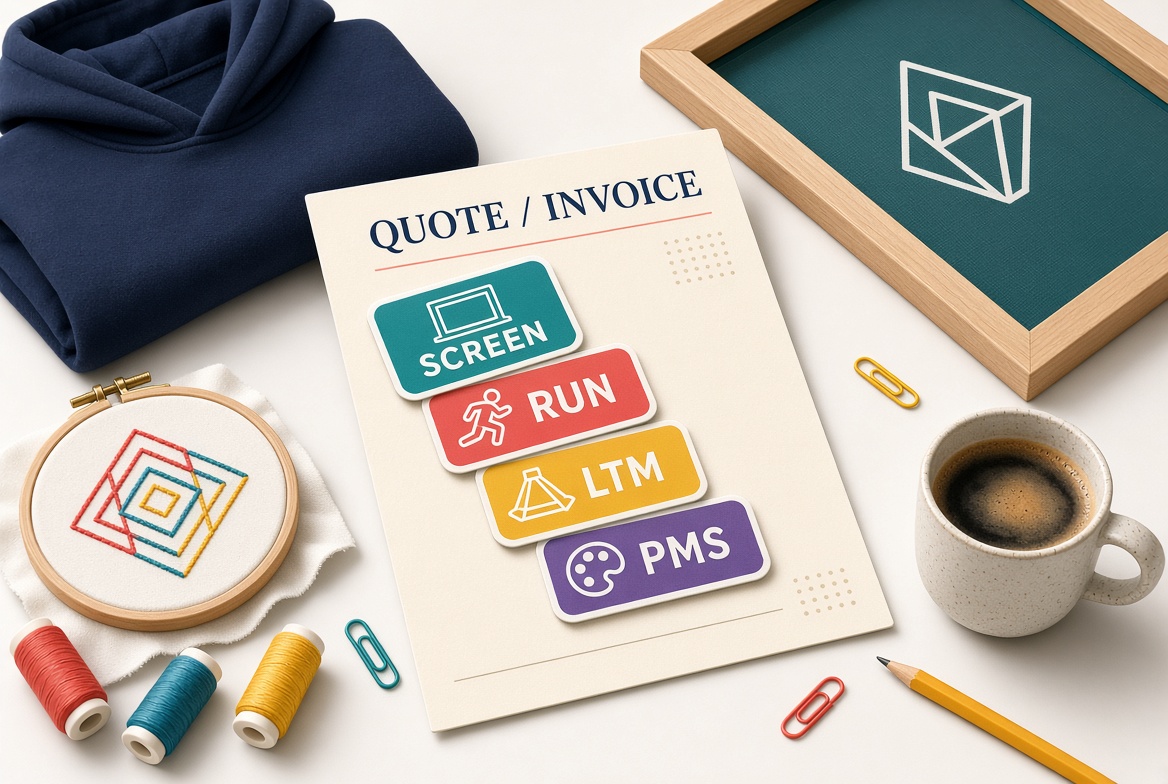
Quick answer: a setup fee is a one-time charge to prepare your art for a decoration method: a screen, plate, digitized embroidery file or die. Typical setup runs $25 to $75 per color or location. A run charge is a per-piece fee for each extra color or location. A less-than-minimum (LTM) fee, usually $35 to $75, lets some products run below the published minimum. Your quote should list each one on its own line.
You asked for a price on 100 hoodies.
The quote comes back with several line items you did not expect: a screen charge, a run charge, something called an LTM fee, maybe a PMS color-match fee.
The price per hoodie looked reasonable. Then the total came in higher than expected.
Most of those charges cover a real production step. Some are standard for the decoration method, some depend on the supplier, and a few are worth questioning before you approve the order.
This guide explains what each charge pays for, when it applies, and how it affects your total.
If you want to understand the entire quote from product price through freight, start with our guide to how to read a promotional products quote.
About the dollar amounts in this guide: All prices are planning examples only. Actual promotional product setup fees and decoration charges vary by supplier, product, artwork, quantity, decoration method, and current pricing. Your written quote controls.
What is a promotional product setup fee?
A setup charge covers production preparation before the first item is decorated. It's one step in the full ordering timeline.
The exact work depends on the decoration method.
For screen printing, it may involve preparing screens.
For embroidery, it may involve converting artwork into a stitch file.
For pad printing, hot stamping, or other methods, it may involve preparing a plate, die, or production file.
The important part is that setup is usually a fixed cost.
That means it affects small orders much more than large ones.
For example, imagine a $50 setup charge.
Quantity | Setup cost per piece |
|---|---|
25 pieces | $2.00 |
50 pieces | $1.00 |
100 pieces | $0.50 |
500 pieces | $0.10 |
The setup cost did not change.
Only the number of products sharing that cost changed.
That's one reason small promotional product orders can have a noticeably higher delivered cost per piece.
What does "free setup" actually mean?
The production preparation behind setup still has a cost, even when the customer sees a $0 setup line.
If a promotional product offer says free setup, several things may be happening:
The supplier program absorbs the setup cost at that quantity.
The distributor absorbs the charge.
The setup is included inside the product or decoration price.
A promotional program temporarily waives the normal setup charge.
All of those can be legitimate.
The important thing isn't whether the setup line says $0.
The important thing is the total delivered price.
For example, a quote with no setup fee but a product price that is $0.40 higher may not be cheaper than a quote that shows setup separately.
Compare totals on the same product, quantity, decoration, and shipping destination.
Screen printing setup fees
Screen printing commonly requires production setup based on the number of print colors and locations.
Each color in a traditional screen-printed design normally requires its own screen.
Each additional print location may also require separate setup.
For planning purposes, a basic screen charge may sometimes fall around $20 to $30 per screen, although supplier pricing varies.
Example
Suppose your shirt has:
Two colors on the front
One color on the sleeve
That can require three screen setups.
At a hypothetical $25 per screen:
Setup | Planning example |
|---|---|
Front color 1 | $25 |
Front color 2 | $25 |
Sleeve color 1 | $25 |
Total screen setup | $75 |
Don't assume every supplier invoices screens the same way.
Some list each screen separately.
Some include part of the first setup inside the decoration price.
Some use a single setup line that covers multiple production steps.
Ask:
"Is this screen charge the total setup, or is it charged per color and per location?"
That one question can make quote comparisons much easier.
Embroidery digitizing fees and tape charges
Embroidery doesn't use screens.
Your artwork has to be converted into instructions that tell an embroidery machine where and how to place each stitch.
That process is called digitizing.
Some older supplier terminology still calls this a tape charge.
They generally refer to the same production step.
Planning costs for embroidery digitizing may sometimes fall around $40 to $90, depending on logo size, detail, stitch complexity, and supplier.
A simple left-chest logo will generally require less work than a large, highly detailed design.
Logos containing:
Very small lettering
Fine lines
Gradients
Tiny details
Print-specific effects
may need to be simplified so they reproduce cleanly in thread.
If a quote lists both a digitizing charge and a tape charge for the same logo, ask what each charge represents.
You should understand why both are present before approving the quote.
Die and plate charges
Some decoration methods use a plate or die instead of a screen.
Examples can include certain pad-printing and hot-stamping applications.
Planning charges may sometimes fall in the $40 to $60 range, depending on the process and supplier.
Again, treat that as an illustration rather than a standard industry price.
Laser engraving setup
Laser engraving may include an artwork preparation, programming, or setup charge.
A planning amount may sometimes fall around $40 to $50, although many supplier programs structure laser pricing differently.
Some include preparation in the decoration price.
Others list it separately.
The quote should tell you what applies to the specific product.
Mold and tooling charges
Custom-shaped promotional products are a completely different category.
If a product requires:
A custom mold
New tooling
A custom shape
New manufacturing hardware
the cost can be substantially higher than a normal decorating setup fee.
Tooling can reach hundreds or even thousands of dollars depending on the product.
Don't compare a custom tooling charge with the routine setup fee on an existing catalog item.
They are paying for very different work.
How color count and print location increase cost
Screen-printing costs can increase in two ways:
Additional screens during setup
Additional per-piece decoration charges during production
The second one can become much more important on larger orders.
Here is a planning example using:
$25 per screen
$0.65 per piece for an additional color or location
These are example numbers only.
Design | Screens | Setup once | Extra run on 250 pieces | Combined add-on |
|---|---|---|---|---|
1 color, chest only | 1 | $25 | $0 | $25 |
2 colors, chest only | 2 | $50 | $162.50 | $212.50 |
2 colors chest + 1 color sleeve | 3 | $75 | $325 | $400 |
4 colors chest + 1 color sleeve | 5 | $125 | $650 | $775 |
Notice what happens.
The setup cost grows, but the per-piece run charges can grow much faster.
That's why decoration planning should happen before you finalize the order.
Simplifying a four-color design to one or two colors can sometimes reduce both setup and per-piece decoration costs while keeping the logo recognizable.
For a deeper apparel example, see our guide to what custom t-shirts actually cost.
If the artwork is detailed and full-color and the quantity is small, it may make more sense to change the decoration method instead of trying to reduce screen charges.
What is a run charge?
A setup fee is usually fixed.
A run charge is normally a per-piece fee for additional decoration work.
It can apply to things such as:
Additional print colors
Additional imprint locations
Extra embroidery locations
Certain specialty decoration steps
Planning run charges may sometimes fall around $0.40 to $1.25 per piece, depending on supplier and method.
Why run charges matter
Suppose 250 shirts have an additional decoration that costs $1.00 per piece.
That adds:
250 × $1.00 = $250
The setup charge might only have been $50 or $75.
The run charge becomes the bigger number because it repeats across every item.
On larger orders, this is one of the most important things to watch.
Full-color digital transfers
Full-color digital transfer methods, often referred to as DTF for apparel, change the cost structure.
Instead of preparing a separate screen for every color, the full design is produced digitally and transferred to the garment.
That means a five-color design doesn't necessarily require five screen setups.
Pricing is more commonly influenced by factors such as:
Imprint size
Transfer size
Quantity
Garment
Application requirements
For a small or moderate order with a detailed multi-color logo, a digital transfer can sometimes be more economical than traditional multi-color screen printing.
For a large order with a simple one-color design, screen printing may still provide a lower per-piece cost.
If your job falls between those situations, ask for both methods.
Our screen print vs. DTG vs. embroidery guide can help you understand the differences.
Worked example: 100 hoodies
Here is a hypothetical quote so you can see how separate charges can stack.
These are planning figures, not a Trendy Promo bid.
The job
100 midweight hoodies
Two-color left-chest logo
One-color sleeve logo
Two exact PMS colors requested
Supplier minimum is 144 pieces
Line | What it covers | Planning example |
|---|---|---|
Hoodies | Blank garments | Quoted separately |
Base decoration | First color, first location | Quoted separately |
Screen setups, 3 | Two chest screens + one sleeve screen | $75 |
Extra-color run | Second chest color × 100 | $65 |
Extra-location run | Sleeve print × 100 | $85 |
LTM fee | Order is below 144-piece minimum | $50 |
PMS match, 2 colors | Custom-mixed brand colors | $40 |
Decoration add-ons | On top of product + base decoration | $315 |
That $315 works out to:
$3.15 per hoodie before freight.
None of those additional charges may have been visible in the basic catalog product price.
Now consider what happens if the order moves from 100 pieces to the published 144-piece minimum.
Change at 144 pieces | What may happen |
|---|---|
LTM fee | Disappears |
Extra-color run | Increases because there are more pieces |
Extra-location run | Increases because there are more pieces |
Screens | Remain fixed |
PMS preparation | Remains fixed |
Product price | May move to a better quantity break |
Freight | May increase, but not necessarily in direct proportion |
That's why ordering fewer pieces isn't automatically cheaper.
Ask for the delivered total at both quantities before deciding.
Want the actual numbers for your artwork? Send us the file and the two quantities you're comparing, and we can price the same specification at both quantities.
What "Price Includes 1 Color, 1 Location" Means
Catalog prices often say they include a one-color imprint in one location. That usually means the first run charge is built into the unit price. It doesn't mean setup is included. You still pay the setup for that first color unless the quote says otherwise, and every added color or location brings its own setup and run charge.
How Full-Color Setup Fees Work
Full-color methods such as digital transfers, DTF, UV printing and four-color process don't need one screen per color. Many suppliers charge one setup per design and location instead, so a six-color logo can cost less to set up in full color than in screen printing. The trade-offs: the unit price is often higher, exact PMS matches aren't always possible, and some products only offer full color in certain imprint areas. Ask for both versions on the same quote when the logo has more than three colors.
Less-than-minimum fees, or LTM charges
LTM means less than minimum.
Some suppliers will accept an order below the published minimum and add a fee to cover the inefficiency of producing a shorter run.
Others won't go below minimum at all.
When a small run is possible, an LTM fee is usually $35 to $75, depending on the supplier and product.
The cost has a much bigger effect on small quantities.
For example:
A $50 LTM charge on 25 pieces adds another $2.00 per piece.
It can also create an interesting pricing situation.
When you increase the order to the supplier minimum:
The LTM fee may disappear
The quantity price may improve
Fixed setup costs get divided across more products
Freight may not rise proportionally
Before approving a below-minimum order, ask:
"What is my delivered total at this quantity, and what is my delivered total at the published minimum?"
Sometimes the difference is much smaller than expected.
Artwork charges
A clean production-ready vector file can help prevent unnecessary artwork charges.
But even a good vector file doesn't guarantee that no production preparation will be necessary.
The production team may still need to:
Resize artwork
Separate colors
Adjust line thickness
Simplify small details
Prepare embroidery artwork
Correct issues specific to the decoration method
If the only artwork available is a small JPG, PNG, website image, or screenshot, the logo may need to be recreated.
Planning artwork-redraw fees can sometimes fall around $25 to $75, depending on complexity.
Our artwork file requirements guide explains which file formats are most useful for production.
Digital proofs and physical samples
A digital proof is a visual representation showing how your artwork is expected to appear on the product.
At Trendy Promo, artwork and the e-proof are part of the quoted service, so the proof isn't a separate line. If your logo needs a full vector redraw, that is typically $30 to $75 and shows on the quote before you approve.
A physical pre-production sample is different.
That requires an actual item to be decorated and often involves:
Product cost
Decoration cost
Setup
Freight
Additional production time
When comparing quotes, make sure you know which type of proof or sample is being offered.
"Proof included" and "physical sample included" aren't the same thing.
PMS color-match charges
Some screen-printing orders require an exact Pantone color.
That may require custom ink preparation.
Planning PMS color-match charges may sometimes fall around $15 to $30 per color, depending on the supplier and decoration program.
An exact match can make sense when:
Corporate brand standards require a specific Pantone
Color consistency is important across campaigns
The product is customer-facing or part of a controlled brand program
But not every order needs custom-mixed ink.
If your brand standards allow a close stock color, ask whether an existing ink can be used.
For a community giveaway or casual event, the nearest stock ink may be completely acceptable.
For a tightly controlled corporate identity, paying for the exact match may be worthwhile.
Rush and expedite charges
Rush orders can create costs in more than one place.
The first is rush production.
The second is expedited transportation.
They aren't the same charge.
A supplier may charge a flat rush fee, a percentage surcharge, or use product-specific rush pricing.
Freight may then increase separately if you need:
2-day service
Overnight service
Expedited movement of blanks to the decorator
A planning rush production fee might sometimes be around $30 to $50 or a percentage of the order, but actual programs vary significantly.
The freight increase can easily be larger than the rush production charge, especially on heavy apparel orders.
Rush programs also frequently have restrictions involving:
Product selection
Quantity
Decoration method
Color count
Artwork
Approval cutoff
Inventory
If the event date is driving the order, tell the distributor the in-hands date before choosing the product.
Split shipments and individual-address fees
Shipping one carton to one loading dock is different from shipping products individually to 50 homes.
Individual-address fulfillment may require:
Separate packing
Address validation
Individual shipping labels
Additional packaging
Tracking
Fulfillment labor
Programs that provide this service may charge additional handling per destination.
A planning amount might sometimes be around $10 to $25 per address plus freight, but pricing varies widely based on product weight, packaging, destination, carrier, and fulfillment program.
Tell the distributor about multiple destinations before the quote is finalized.
A quote based on one delivery address can change substantially if 40 residential addresses are added later.
Which promotional product charges should you question?
Questioning a fee doesn't mean the charge is wrong.
It means you understand what you're paying for.
Ask:
Is this setup fee total, or per color?
Is setup also charged for each print location?
Does my artwork require embroidery digitizing?
Is "tape charge" simply another name for the digitizing fee on this quote?
What is driving this run charge?
Is PMS matching required?
Can a stock ink be used instead?
What setup charges apply on an identical reorder?
Is my quantity below the supplier minimum?
What would the total be at the published minimum?
Is this a digital proof or a physical sample?
Does the quote include split-shipment handling?
Would DTF or another full-color method reduce the per-color charges?
If setup is listed as free, how does the total delivered price compare?
A clear quote should make those questions easy to answer.
What happens to setup fees when you reorder?
It depends on the decoration method.
Embroidery reorders
Once an approved embroidery stitch file exists, it can normally be reused for an identical design.
If the:
Artwork
Logo size
Placement
Embroidery specifications
remain unchanged, new digitizing may not be necessary.
Ask whether the stitch file is being kept on record and whether any repeat-order preparation charge applies.
Screen-printing reorders
Screen printing works differently.
Physical screens are commonly reclaimed after production rather than stored indefinitely.
That means an identical reorder may require new screen preparation.
Some supplier programs reduce or waive repeat setup for a certain period.
Others charge the normal screen setup again.
Ask before the first order:
"What setup charges would apply if I reorder this exact design six months from now?"
That gives you a better understanding of the long-term cost.
What Trendy Promo does
We want buyers to understand what they are paying for.
Where applicable, our quotes can separate items such as:
Product cost
Decoration
Setup
Run charges
Freight
Fulfillment
That makes the tradeoffs easier to see.
If removing one print color saves a meaningful amount, you can see where the savings come from.
If increasing the quantity removes an LTM fee and creates a better quantity price, you can compare both options.
At Trendy Promo the e-proof is included in the quoted service, not billed as its own line.
When a supplier program allows a setup charge to be reduced, waived, or absorbed, we can reflect that in the quote while still showing you the total delivered cost.
When a setup charge is unavoidable, we want you to understand what the line pays for.
If you don't recognize a fee, ask us.
You can review more of our commitments on the return and reprint policy or send us your artwork for a quote.
How do you know how much setup and full-color fees you should pay?
You can't judge a setup fee in isolation. You judge it against the decoration method, the number of colors and locations, and the quantity. Use this check on any quote.
Match the fee to the method. Spot-color methods such as screen printing and pad printing charge per color and per location. Full-color methods such as digital transfers usually charge one setup per design and location. Embroidery charges a digitizing fee for the stitch file. Laser engraving usually has a single setup.
Count the lines. A three-color logo on the front and a one-color mark on the back is four spot-color setups. Quote shows a different count? Ask why.
Divide by quantity. Add every one-time charge, divide by the number of pieces and add it to the unit price. There's your real cost per piece.
Price the full-color option side by side. On a logo with many colors, one full-color setup can cost less than several spot-color screens. On a one-color logo, spot color usually wins.
Ask about reorders. If you will run the same art again, ask whether the stitch file, plate or screen setup can be reused.
Numbers still don't add up? Send us the quote and we'll walk through it line by line. Call 888-200-8672.
Setup fee vs. run charge vs. LTM fee
These three lines get confused more than any others. The difference is how each one behaves as quantity changes.
Charge | Charged | Changes with quantity? | Usually triggered by |
|---|---|---|---|
Setup fee | Once per color, location or design | No. Its share per piece shrinks as quantity grows | Any new decoration |
Run charge | Per piece | Yes. It grows with every piece | Extra colors or locations beyond what the price includes |
LTM fee | Once per order | Disappears at the published minimum | Ordering fewer than the minimum |
On small orders, setup and LTM fees dominate. On large orders, run charges usually matter more. So the cheapest decoration at 50 pieces isn't always the cheapest at 500.
What is a run charge, in one sentence?
A run charge is a per-piece fee for each additional color or imprint location beyond what the listed price includes, and unlike setup it doesn't shrink as you order more.
What is an LTM fee, in one sentence?
An LTM, or less-than-minimum, fee is a flat surcharge that lets some products run below the published minimum quantity. When the price at the minimum lands close to your LTM total, ordering the minimum is often the better value.
Overruns and underruns
Some decoration methods can't hit an exact count, so suppliers may ship slightly more or fewer pieces than ordered and bill for what ships. The allowance depends on the supplier and product. If you need an exact count for an event or a named list, say so before production and ask how the order will be handled.
Ink change and personalization charges
Two smaller lines show up on some quotes:
Ink change: printing the same art in different ink colors on different product colors means the press must be cleaned and re-inked. Grouping product colors by ink can reduce or avoid it.
Personalization: individual names or numbers on each piece are priced per piece because each one is handled separately. Engraved names on a milestone list are a common example.
Questions to ask before you approve a quote
How many colors and locations does the unit price include?
How many setup lines are on this quote, and what does each one cover?
Is there a run charge, and is it per color, per location or both?
What would the total be at the next quantity break?
Would a full-color method cost less than spot color for this art?
Can setup be reused on a reorder of the same art?
Does the total include freight to the delivery address?
For the full sequence from first quote to delivery, see how to order promotional products. If your art isn't production-ready, check the artwork requirements first, since file fixes are a common source of extra lines. To compare decoration methods before you quote, read screen print vs. DTG vs. embroidery.
Quick reference: common promotional product charges
The ranges below are planning examples only. Actual supplier pricing varies. Same logic for one-color shirt orders, logo pens for events or engraved tumblers.
Charge | Planning range | When it may apply | How to reduce it |
|---|---|---|---|
Screen setup | $20 to $30 per screen | Screen printing colors and locations | Use fewer colors or locations |
Digitizing / tape charge | $40 to $90 | Preparing embroidery artwork | Reuse an approved stitch file |
Die or plate | $40 to $60 | Certain pad-print or hot-stamp jobs | Reuse existing production setup when allowed |
Laser setup | $40 to $50 | Certain engraved products | Consolidate designs |
Run charge | $0.40 to $1.25 per piece | Additional colors or locations | Simplify decoration or change methods |
LTM fee | $35 to $75 | Ordering below supplier minimum | Compare price at the published minimum |
PMS match | $15 to $30 per color | Exact Pantone ink matching | Use stock ink when acceptable |
Artwork charge | $25 to $75 | Logo needs rebuilding or correction | Supply production-ready artwork |
Rush production | $30 to $50 or percentage surcharge | Compressed production timeline | Order earlier when possible |
Digital proof | Included in the quoted service | Standard artwork approval | Included |
Split shipment | Often $10 to $25 per address plus freight | Multiple delivery locations | Consolidate destinations |