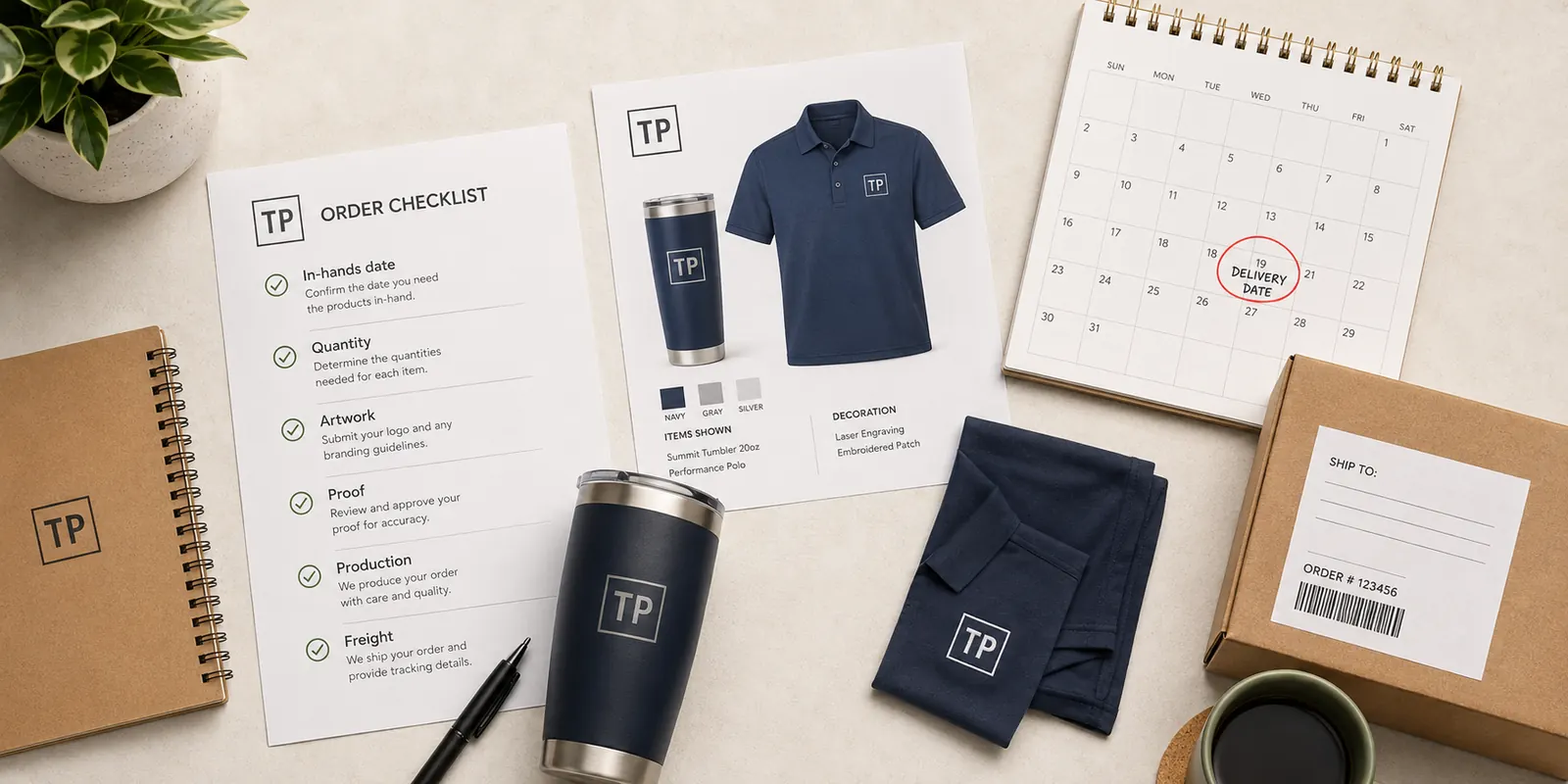
How to Order Promotional Products Without Missing the Date
Most late merch orders did not fail in production. They failed in the brief.
The in-hands date was treated as a hope. The catalog price was treated as the budget. The logo file was a screenshot. The proof sat in an inbox for four days. Freight was an afterthought. None of that shows up on a product page. All of it decides whether the box arrives when the event, the new hire, or the client dinner still exists.
This page is the sequence we use before anyone picks a color. It covers promotional products for businesses across the USA: what to lock first, how long a normal order actually takes, what a proof can and cannot show, when a sample is worth the days it costs, and how to compare quotes without getting fooled by a cheap unit price.
If you already know the product type and only need selection help, use the matching guide instead. Promotional drinkware owns bottles and tumblers. The bulk custom apparel guide owns size runs. Trade show giveaways owns booth handoffs. This page is the order itself.
Start with the date, not the catalog
Write the in-hands date first. That is the day the item must be in someone’s hands, not the day a tracking number appears.
Work backward from that date:
Freight and receiving
Production
Proof approval
Artwork cleanup
Sampling, if the piece has to feel right
Product shortlist and quote
A standard decorated order, after proof approval and payment, often needs 5 to 15 business days in production and 2 to 7 business days on ground freight. Many programs land in a 2 to 4 week window from a clean brief to a dock. That is a planning number, not a promise on every SKU. Apparel with a size curve, kits going to many addresses, and battery products take longer. Confirm the current window on the item you actually chose.
Rush exists on some products. It is a premium, and it is not available on everything. If the date is tight, say so in the first email. Do not pick a 40-ounce wrap tumbler and then ask for 24-hour production.
Need a dollar cap before you shortlist? Use the budget calculator and work from quantity plus spend, not from a catalog hero shot.
Write a brief that can be quoted
A usable brief is short. It is also specific. That holds whether you need custom promo items for one event or custom promotional items for a full year of programs.
Send this in one note:
Who receives it (employees, clients, booth visitors, field crew)
What you want them to do with it
Quantity, plus a small overage if replacements matter
In-hands date and ship-to pattern (one dock or many homes)
Budget per piece delivered, not undecorated
Current logo file and any color rules
Workplace limits (no vendor marks in a clinic, no glass in a warehouse, certified hi-vis if the site requires it)
If five managers each send a different version of that list, you will get five quotes that cannot be compared. One owner of the brief is cheaper than a week of revisions.
Browse the product catalog after the brief exists, not before. The catalog is useful once you know the job.
Compare delivered cost, not the line price
The number on the product tile is the start of the quote. It is rarely the end.
Delivered cost usually includes some mix of:
Blank product
Decoration and setup
Proof
Sample, if you need one
Packaging or kitting
Freight
Individual-address fees
Less-than-minimum fees on small runs
Replacement units
A $4.50 item that needs a setup charge, a two-color imprint, mailers, and 80 home addresses is not a $4.50 program. A $9 item that ships in one carton to one office can be the cheaper buy. Setup and screen charges are explained line by line in our setup fee breakdown.
If you later have to defend the spend, cost it the way the ROI guide frames it: program cost, not the pretty unit price.
Quote line that looks cheap
What to ask
Low unit price
Does that include decoration?
“Free setup”
On which method and quantity break?
Fast production
After proof approval, or from today?
Ground included
To one address or to the full list?
Rush available
On this SKU, this decoration, this week?
If two quotes cannot answer those five questions, they are not comparable.
Artwork that can be decorated
A proof cannot rescue a bad file.
Send vector art when the method needs a clean edge (most screen, pad, and embroidery work). A PNG pulled from a website is a picture of a logo, not a logo. If the only file you have is flattened, say so early. Cleanup is a real step. It belongs on the calendar. Our artwork file checklist lists the formats decorators accept.
Also send:
The current mark, not last year’s
Color intent (PMS if you have it, or “match this as close as stock ink allows”)
Where the mark should live (chest, cap front, bottle side)
What must never appear (old tagline, wrong legal line)
Embroidery is stitches, not ink. Fine hairlines and full-color photographs do not survive that translation. Laser on metal follows the finish. A wrap print follows the curve. The method decides the art, not the other way around.
Ordering mechanics (file types, minimums, rush language) live on the FAQ. Use that page for the policy answers. Use this page for the sequence.
What a proof is for
A digital proof shows placement, size, and approximate color on a drawing of the product. Approve it when those three things are right. If the date is already tight, check what a 24-hour rush can realistically deliver.
A proof does not show:
How heavy the piece feels
Whether the lid leaks
How the imprint looks after a dishwasher cycle
How a PMS target looks on a coated bottle versus a cotton polo
How a size actually fits
Approve once. Every change after approval can restart the production clock. If two people must sign, put both names on the brief so the proof does not sit in a thread.
If the program is visible (client gifts, executive kits, a piece that will be photographed), order a sample or a decorated sample on the same construction. A sample costs days. A four-figure reprint costs more.
Sample when the hand has to agree with the photo
Sample if any of these are true:
Recipients will judge quality in the first five seconds
The lid, zipper, or fit is the product
You are drop-shipping to homes and packaging matters
Color is part of the brand promise
You have never bought this construction before
Skip the sample when the item is a known, low-risk handout and the date cannot absorb the extra transit. In that case, pick a simpler SKU. Do not skip the sample and keep the risky product.
Test the sample the way the recipient will use it. Put the bottle in a bag. Wear the polo for a day. Open the lid one-handed. Read the care line on the decorated piece, not the blank.
Production, freight, and the dates people forget
Production time starts after art approval and payment, not after the first “looks good” text.
Build buffer for:
Weekends and supplier closures
A second proof if someone changes the mark
Apparel size exchanges
Kits that have to be packed, not just printed
Residential delivery on a list that arrives late
Battery products that cannot fly the way a mug can
One ship-to is a freight problem. Eighty ship-tos is a data problem. Collect addresses and sizes before you approve the proof, or the carton waits on a spreadsheet.
24-hour rush is for SKUs that are built for it. It is not a setting you apply to any item in the catalog. If the date only works on rush, choose from what can actually move that fast.
Ordering for a show? Budget the booth along with the merch: here is how much a trade show booth costs once services and freight are in.
Pick the order type before you pick the SKU
You need
Order type
Do not turn it into
One event, one date, one dock
One-off quote
A 40-SKU store
The same box every time someone is hired
Kit program
A new design each month
Employees reordering approved gear all year
A public catalog with no rules
A thank-you for a short client list
One-off with packaging
A booth wrap tumbler
Wrong order type wastes more calendar than wrong color.
A working timeline
Use this as a planning skeleton, then confirm the live window on the product.
Four weeks out. Brief, quantity, budget, in-hands date, logo file.
Three weeks out. Shortlist two or three items. Quote on delivered cost. Sample if needed.
Two weeks out. Approve the proof. Lock sizes and addresses. Pay so production can start.
One week out. Production finishes. Freight is booked. Receiving knows a carton is coming.
In-hands day. The item is in the room, not on a truck two states away.
Compress that only when the SKU, the decoration, and the supplier path support it. Compression is a product choice.
Mistakes that make good products late
Sending the date after the quote
Treating setup, freight, and kitting as optional
Approving a proof from a phone screenshot
Changing the logo after the supplier booked the line
Ordering apparel without a size curve or an exchange plan
Adding names when the list is not final
Choosing a battery item with a tight air window
Splitting the order across three vendors with no owner
None of those are decoration problems. They are brief problems.
What to send us
If you want a shortlist instead of a catalog tour, put the brief in a concierge request: audience, quantity, in-hands date, budget range, artwork, and any site rules. We will tell you which products can hit the date, what the delivered cost looks like, and whether a sample or a simpler SKU is the safer move. If you just need a dependable first order, insulated tumblers are easy to spec.
For policy questions (minimums, tax, proofs, rush language), use the FAQ. For product fit, use the category guides. For the order itself, stay on this page.
Frequently asked questions
How long does it take to order promotional products?
Plan 2 to 4 weeks for a standard decorated order after you have a clean brief. Production after proof and payment is often 5 to 15 business days, plus ground freight. Complex kits, apparel size runs, and battery items need more. Confirm the window on the SKU.
When should I request a rush?
When the in-hands date cannot absorb a standard cycle and the product is actually eligible. Ask in the first message. Rush after art changes is how programs miss the dock.
Do I need a sample?
Yes if feel, fit, lid, color, or packaging will decide whether people keep the item. No if it is a simple handout and the calendar cannot take the extra transit. In that case, pick a simpler product.
What file do you need for the logo?
Vector when the method needs a clean edge. If you only have a flattened file, send it early so cleanup sits on the calendar instead of in the crisis.
Why is the quote higher than the website price?
The tile price is usually the blank or a base decoration at a stated quantity. Setup, extra colors, packaging, freight, and split ship-tos sit on top. Compare delivered cost.
Can I change the design after I approve the proof?
You can. The clock often restarts. Approve once, with the people who actually have to live with the mark.