How to Choose the Right Promotional Drinkware for Your Brand
Most branded drinkware fails for a boring reason. The piece looked good in a catalog. It did not fit the day the recipient actually lives. For desk-bound teams, our guide to choosing coffee mugs goes further.
A 40-ounce wrap tumbler can be a hit at a booth and a problem in a law office. A ceramic mug can feel thoughtful on a desk and expensive once you start shipping one to every new hire. A bottle with a clever lid can sit unused if that lid takes two hands to open on a jobsite.
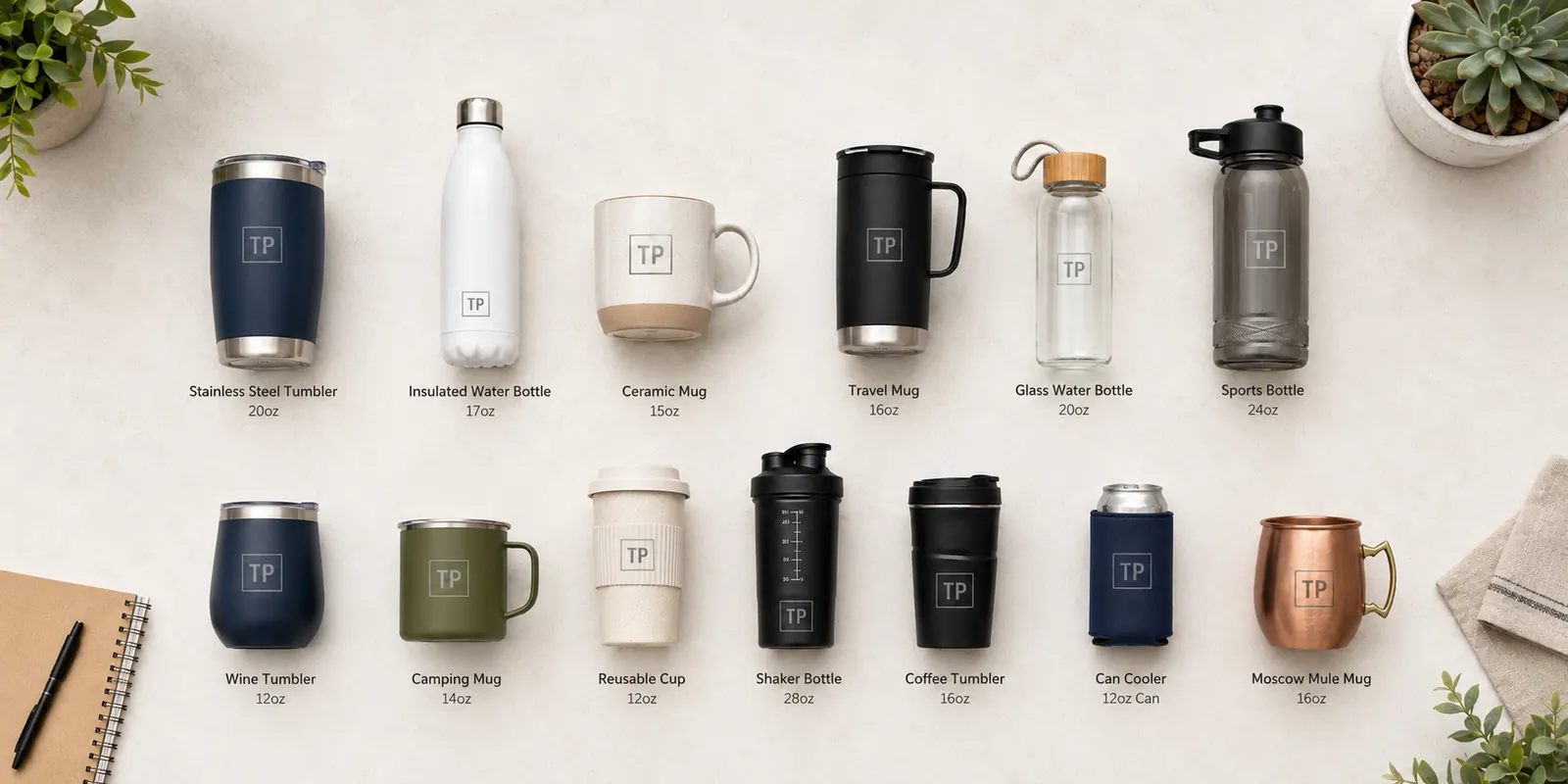
This guide is the selection process we use before anyone picks a color. It covers promotional bottles, insulated tumblers, custom mugs, travel mugs, and reusable cups by audience, material, capacity, lid, decoration, care, budget, and intended use.
Drinkware type
Best for
Typical priority
Water bottle
Fitness, events, outdoor programs
Portability
Insulated tumbler
Employees, clients, commuters
Insulation
Ceramic mug
Offices, welcome kits
Comfort
Travel mug
Mobile teams, drivers
Cup-holder fit
Reusable cup
Events, large campaigns
Quantity and value
Start with the audience and the occasion
Ask where the piece will live most days:
Desk. Ceramic mug or a compact insulated tumbler.
Bag. Leak-conscious tumbler or bottle that fits a cup holder.
Truck or field bag. Durable bottle, simple lid, no fragile finish.
Booth or event table. Lightweight reusable cup or bottle people can carry out.
Same logo. Four different products. That is why “just get tumblers” is not a strategy. For premium client gifts, our S’well bottle guide covers corporate minimums.
Match the drinkware style to the use case
Water bottles for active and on-the-go audiences
Reusable water bottles fit wellness programs, schools, field teams, gyms, and commuters. Look at carry, lid operation, and whether the shape fits the bags or holders your audience already uses.
Wide mouths make filling and ice easier. Narrower mouths are often easier while walking. Loop caps help at events. Every extra lid part also has to be cleaned and, eventually, replaced.
Insulated tumblers for commuting and daily desk use
Tumblers earn their keep with employees, clients, conferences, and programs where the piece should feel like something someone would buy. Double-wall vacuum insulation is common on metal products. Temperature times vary by construction. Only repeat the supplier’s documented spec.
Read the lid like a product, not an accessory. Sliding, press-in, threaded, and straw lids create different days. Not every lid is built to ride in a laptop bag. If spill resistance matters, confirm the claim. Do not infer it from the photo.
For client programs, keep the silhouette compact and the mark quiet. That is the same rule we use in client appreciation gifts.
Ceramic mugs for offices, welcome kits, and hospitality
A ceramic mug already belongs in a kitchen. That is why it works for onboarding, office programs, hospitality, and quieter client gifts. Handle clearance, rim, balance, and weight decide whether it gets used or parked.
Ceramic needs protective packaging. If you are drop-shipping to homes, budget extra packaging and a few replacement units. Confirm microwave, dishwasher, and care notes on the decorated item, not the blank.
If the mug is going into a new-hire box, pair this page with the employee welcome kit checklist.
Travel mugs for mobile teams
Travel mugs (most sit in the tumbler range) emphasize controlled sipping and cup-holder fit. They suit sales teams, drivers, technicians, and hybrid employees who change rooms all day.
Compare base diameter, lid operation, grip, and capacity. Smaller is easier to carry. Larger means fewer refills and more weight. The right tradeoff is the recipient’s workday, not the catalog hero shot.
Reusable cups for events and high quantity
Single-wall or double-wall reusable cups work for festivals, campus programs, and large handouts. They usually give you color range and a generous decoration area at event quantities.
Check wall construction, lid fit, feel, and intended drink temperature. If campaign copy will mention material or reuse, get the documentation first.
Do not turn an event cup into a client gift.
Quick pick by campaign
Use case
Usually choose
Usually skip
Decoration that fits
Office desk / welcome kit
Ceramic mug or 16 to 20 oz tumbler
40 oz wrap, glass without packing plan
One-color imprint or laser
Daily commute
Insulated tumbler, secure lid
Open ceramic, leaky straw lid
Laser or single-color
Field / outdoor / warehouse
Durable bottle, simple lid
Fragile glass, heavy ceramic mailers
Durable imprint, high contrast
Client / executive thank-you
Compact insulated piece, individual shipper
Full-wrap “booth” artwork
Laser or small one-color mark
High-volume event
Reusable cup or lightweight bottle
Premium ceramic drop-ship
Bold one- or two-color
Company store staple
One compact bottle or tumbler
A dozen colorways of the same cup
One approved mark placement
That last row is why drinkware belongs on a tight shelf, not an 80-SKU catalog.
Compare materials before you compare colors
Material changes weight, durability, insulation, decoration, care, freight, and how expensive the piece feels. Color is the last decision, not the first.
Stainless steel. Default for bottles and tumblers when durability or insulation matters. Brushed, painted, and powder-coated finishes take decoration differently. Laser contrast depends on the coating.
Plastic and acrylic. Light, useful for events and quantity. Confirm the exact resin, care notes, and any food-contact claims.
Ceramic. Familiar for hot drinks and desks. Heavier. Needs real packaging.
Glass. Clean look for office and home. Poor fit for active environments unless packaging and use are planned.
Mixed builds. Metal plus plastic, silicone, or cork. Review how those parts clean and how they age.
If sustainability is part of the message, do not invent the story from a product photo. Match the claim to paperwork. Start with eco-friendly promotional products and only repeat what the supplier documents.
Choose a capacity people will actually carry
Capacity should follow the drink, the setting, and how often someone can refill.
Smaller mugs feel right at a coffee station.
Mid-size bottles and tumblers (roughly 16 to 24 oz) cover most desk and commute days.
Large formats help long shifts and outdoor work. They also get heavy when full and miss a lot of standard holders.
Do not judge size from a thumbnail. Check listed dimensions against the cup holder, bag pocket, dispenser, or shipper you actually use. A sample is faster than a debate.
The lid is the product people touch
Recipients handle the lid more than the logo. That is the part that decides whether the piece stays in rotation.
Ask four things:
Can it open with one hand?
Are loose parts easy to wash?
Is the opening right for hot, cold, or both?
Will it ride in a bag without becoming a story?
Handles add grip and width. Straws add convenience and a cleaning chore. In a workplace, a simple lid usually beats a feature list.
Plan decoration around the vessel
Get the current imprint template before artwork is “final.” Curvature, seams, tapers, handles, and lid alignment all eat logo space.
Laser engraving
Common on compatible metal. Durable and quiet. Final contrast depends on the finish. A proof or decorated sample is worth it when the piece is going to clients.
Screen printing and pad printing
Economical for simple art and larger runs. Imprint size, curve, ink system, and material decide how many colors and how fine the detail can go.
Full-color digital
Useful for gradients and detailed art on approved products. Fine lines and small type still have to clear artwork rules. Color shifts on metallic, dark, and transparent surfaces.
Wraps and second locations
More coverage is not automatically better. A small mark placed where the hand does not cover it often looks more expensive than a mural wrap. That is especially true in professional settings.
Use brand color after the function is locked
Exact vessel color matches are not always available. A screen is not a sample.
Decide whether the cup must match the brand, or whether a neutral vessel plus a matched imprint is cleaner. Dark finishes help some imprints and hide others. Transparent and metallic surfaces change how ink looks. When consistency matters, look at a physical piece.
Build the delivered budget, not the catalog price
Unit price is one line. The real number includes setup, decoration, extra locations or colors, samples, proofing, packaging, freight, individual-address fulfillment, and replacements.
Glass, ceramic, and metal can cost more delivered than a lightweight event cup even when the catalog prices look close.
Large event: prioritize function and a distribution plan you can staff.
Small client or recognition run: a higher product and packaging allowance usually fits the relationship better.
Work backward from quantity and spend with the budget calculator before you fall in love with a SKU. Compare program cost, not the pretty unit price.
Only print claims the spec sheet supports
Insulation time, leak resistance, recycled content, food-contact notes, dishwasher use, and microwave use should come from current supplier documents for the exact SKU.
If your organization has compliance rules, send them before selection. Do not turn a category habit into campaign copy. Ordering questions (minimums, proofs, rush) live on the FAQ.
Order a sample before you produce the run
A sample answers weight, balance, finish, color, lid feel, grip, true capacity, and packaging. For an important program, a decorated sample shows artwork scale and contrast that a PDF will not.
Test it the way recipients will. Approve the piece in the room it will be used (bag, cup holder, kitchen sink), not only on a screen. Check dimensions. Read the care card. Look at the box. Write down the approval so production uses that product, color, and art.
Mistakes that quietly waste the order
Choosing from color first.
Calling a lid leakproof because it looks sturdy.
Sending a 40 oz full-wrap tumbler into a conservative client office.
Drop-shipping ceramic without extra pack-out and spare units.
Promising dishwasher-safe or recycled content without the file.
Ordering capacity from a photo.
Skipping the sample on a program people will notice.
Utility is what keeps the piece.
Drinkware selection checklist
Who receives it, and where do they use it?
Which drink and capacity fit that routine?
Does the material match the weight, durability, and presentation you want?
Is the lid right for desk, commute, event, or travel?
Are care notes and product claims documented for this exact item?
Does the decoration read cleanly on this finish?
Are packaging, freight, and fulfillment in the budget?
Has a sample been reviewed when the program warrants it?
Is there time for proofing, production, checks, and delivery?
Ready to spec the piece?
Function first. Then material and capacity. Then color and decoration. That order is how you get drinkware people keep using.
Explore the promotional drinkware collection, or send audience, quantity, budget, artwork, and date through a concierge request. We will shortlist options and verify current specs before you order. Selling drinkware rather than giving it away? Our restaurant and brewery merch guide covers pricing for the retail shelf. For outdoor events, add can coolers and beverage insulators.