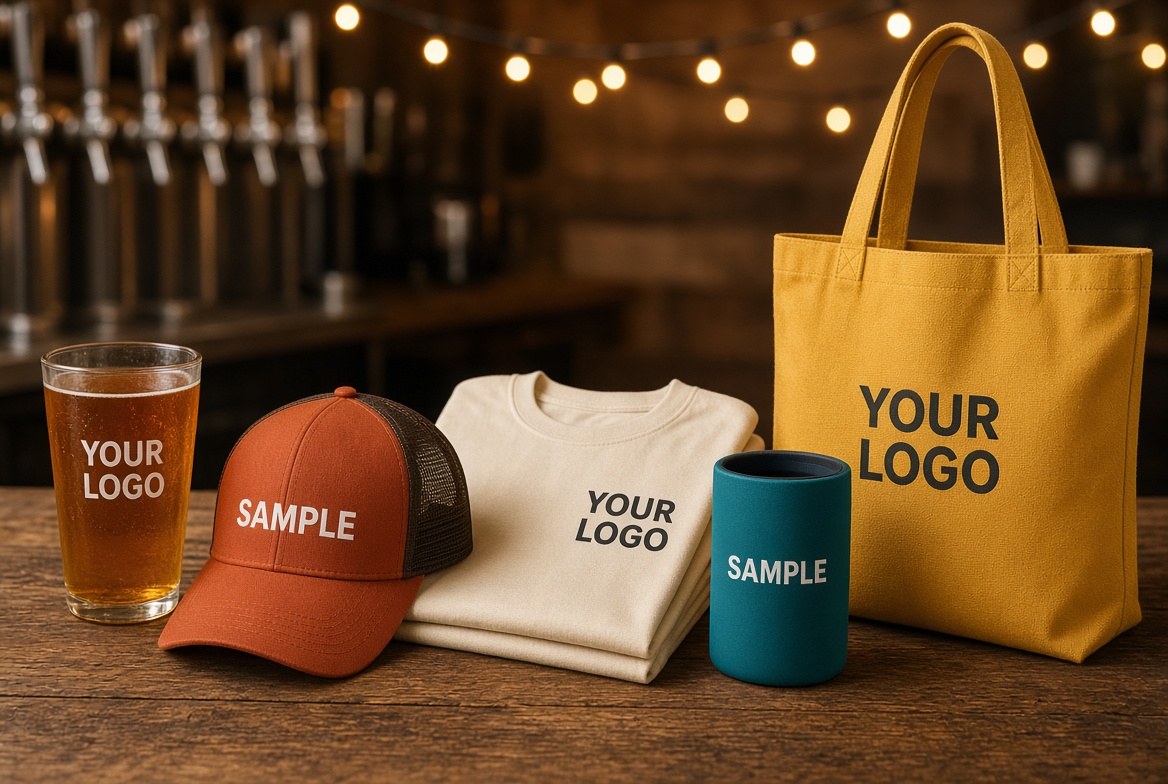
This guide covers restaurant and brewery merch for US taprooms, bars, breweries, cafes, and restaurants.
A full wall of SKUs looks like a brand.
Sometimes it is just a closet with better lighting.
Guests buy products they would wear or use this week. Staff need pieces that survive a shift. Festival crowds want something easy to carry.
Those three jobs should not share one order form.
Quick answer: what tends to sell and what tends to sit
Stronger starting point | Common overbuy |
|---|---|
Soft logo tee in a useful size range | Five colorways of the same shirt |
Trucker cap or everyday cap | Too many fashion hat styles |
Pint, can glass, mug, or sturdy cooler matched to the business | Fragile specialty glassware without a shelf plan |
Can cooler sized for what you actually sell | Novelty shapes with no use case |
One seasonal drop | Permanent wall of dozens of SKUs |
Small sticker or low-price item at the register | Cheap filler dumped into a basket |
Staff uniforms, guest retail, and event giveaways are different programs.
Run three programs, not one pile
1. Guest retail
The goal is to sell something the customer wants to own.
Stock fewer, better products.
Do not choose the retail price only because of what the item cost you. Look at the finished delivered cost and whether the product belongs on your shelf.
2. Staff wear
The job is a shift.
Think durable fabric, easy laundering, appropriate colors, clear sizing, and a logo treatment that works with the uniform.
That is closer to apparel buying than a retail merchandise drop.
Start with custom apparel.
3. Festival and to-go handouts
The job is different again.
These products need to be low enough in cost for quantity, useful enough to keep, and easy to carry.
Can coolers, bottle openers, stickers, and similar pieces can make more sense than expensive apparel.
If leftover event products are later dumped onto the retail shelf, customers can read the display as clearance rather than merchandise.
A focused shelf earns its space
A strong starting assortment might be:
One T-shirt people would wear outside the restaurant or taproom
One cap
One drinkware item that matches how you serve
One lower-price impulse item
Then test demand.
Add another color, product, or seasonal drop because customers earned the expansion, not because the catalog had another page.
For glassware and drinkware details, use the promotional drinkware guide.
A taproom serving 16 oz cans does not automatically need an oversized 40 oz tumbler as its signature retail item.
Match the merchandise to the room.
Why restaurant and brewery merch sits
Merch can stall because:
you ordered streetwear quantities for a small location
the T-shirt is stiff or the print dominates the entire front
the size run does not match customers
the glassware has no connection to what you actually serve
the can cooler does not fit the cans you sell
too many colorways were ordered before demand was proven
nobody owns the shelf
old seasonal products remain at full price indefinitely
leftover event merchandise gets mixed with retail products
Dead merchandise is inventory cost disguised as branding.
Price like a retailer, cost like a program
Your retail margin starts with the selling price minus the real delivered cost.
Delivered cost can include:
blank product
decoration
setup
freight
packaging
storage
breakage
unsold inventory
Use the Budget Calculator before ordering a large seasonal apparel run.
Smaller replenishment orders can sometimes be smarter than trying to predict an entire year's demand in one purchase.
If the same staff tee, cap, or other uniform piece gets reordered continuously, a company store may make sense for the employee side of the program.
Staff design and guest design do different jobs
Staff apparel should survive work.
Guest merchandise should feel like merchandise.
Those can share a brand without using the exact same artwork.
Staff
Consider:
smaller logo
durable decoration
consistent color
fabrics that make sense for the shift
easy reorder rules
useful size availability
Guest retail
You have more room for creativity.
A restaurant name, neighborhood, opening year, local illustration, mascot, brewery art, or other distinctive design can make the piece feel like something people bought because they liked it, not because they wanted to advertise for you.
Do not print the entire menu onto a T-shirt.
Do not make a QR code the main reason somebody notices a cap.
Build a merchandise version of the brand.
Artwork and color guidance is available in the FAQ.
Drinkware should match what you actually serve
This is where restaurants and breweries can make an obvious mistake.
Do not buy a drink product because it is trending online.
Start with the drinking occasion.
A brewery may consider:
pint glasses
can glasses
can coolers
bottle openers
insulated drinkware
A coffee shop may care more about mugs, commuter tumblers, or reusable cups.
A restaurant may choose one versatile drinkware item instead of stocking an entire glassware collection.
Product size, lid, material, decoration area, breakage risk, shipping, and shelf space all matter.
Use the drinkware guide before locking the product.
Seasonal drops should earn the next drop
Limited merchandise can create interest when there is a real reason for it.
Examples:
anniversary
opening week
seasonal beer
summer patio
holiday
local event
collaboration
neighborhood design
But "limited edition" does not create demand by itself.
Start reasonably.
Watch what sells.
Then decide whether the next version deserves inventory.
Staff uniforms are not leftover retail inventory
Do not solve a sizing mistake on the guest shelf by moving the wrong shirts into the employee uniform program. For taprooms, start with pint glasses and drinking glasses, and for other sectors see how other industries buy promotional products.
Staff apparel has another job.
It needs:
predictable sizes
repeat availability
decoration appropriate for the work environment
comfort through a full shift
a clear replacement process
The guest shelf can change.
Uniform rules should be more stable.
What to send with the quote
Include:
guest retail, staff wear, or event handout
restaurant, brewery, taproom, cafe, or bar type
on-premise serving size where relevant
quantity
size curve
in-hands date
artwork
garment or drinkware preferences
where the product will be displayed
expected retail price, if it will be sold
shipping location
Ordering timelines are covered in how to order promotional products.
Frequently Asked Questions
What brewery merch sells best?
There is no universal winner, but a soft T-shirt, wearable cap, and drinkware connected to what the brewery actually serves are practical places to start. Test a small assortment before expanding it.
What are good restaurant merch ideas?
Restaurant merchandise can include quality T-shirts, caps, mugs, tumblers, totes, stickers, and other products connected to the restaurant's identity and customer experience. Keep the initial assortment focused.
How many merch SKUs should a brewery launch with?
There is no fixed number. A focused starting assortment of roughly four core guest products can be easier to manage than a wall of untested inventory. Expand after you see what customers actually buy.
Should restaurants copy brewery merchandise?
Copy the merchandising discipline, not necessarily the products. A restaurant may sell a quiet T-shirt, tote, mug, or cap where a brewery might naturally lean toward pint glasses and can coolers. Guest merch is also a loyalty play, so read what branded merch does for repeat customers.
Can leftover event merchandise go on the retail shelf?
Only if it still looks and feels like a product someone would choose to buy. Event leftovers that look dated or promotional can weaken the retail presentation.
Should staff wear the same shirts sold to customers?
They can, but they do not have to. Staff apparel needs to work through a shift and be easy to replace. Guest merchandise can use more creative artwork and seasonal variation. Keep staff t-shirts on a separate spec from retail shirts.