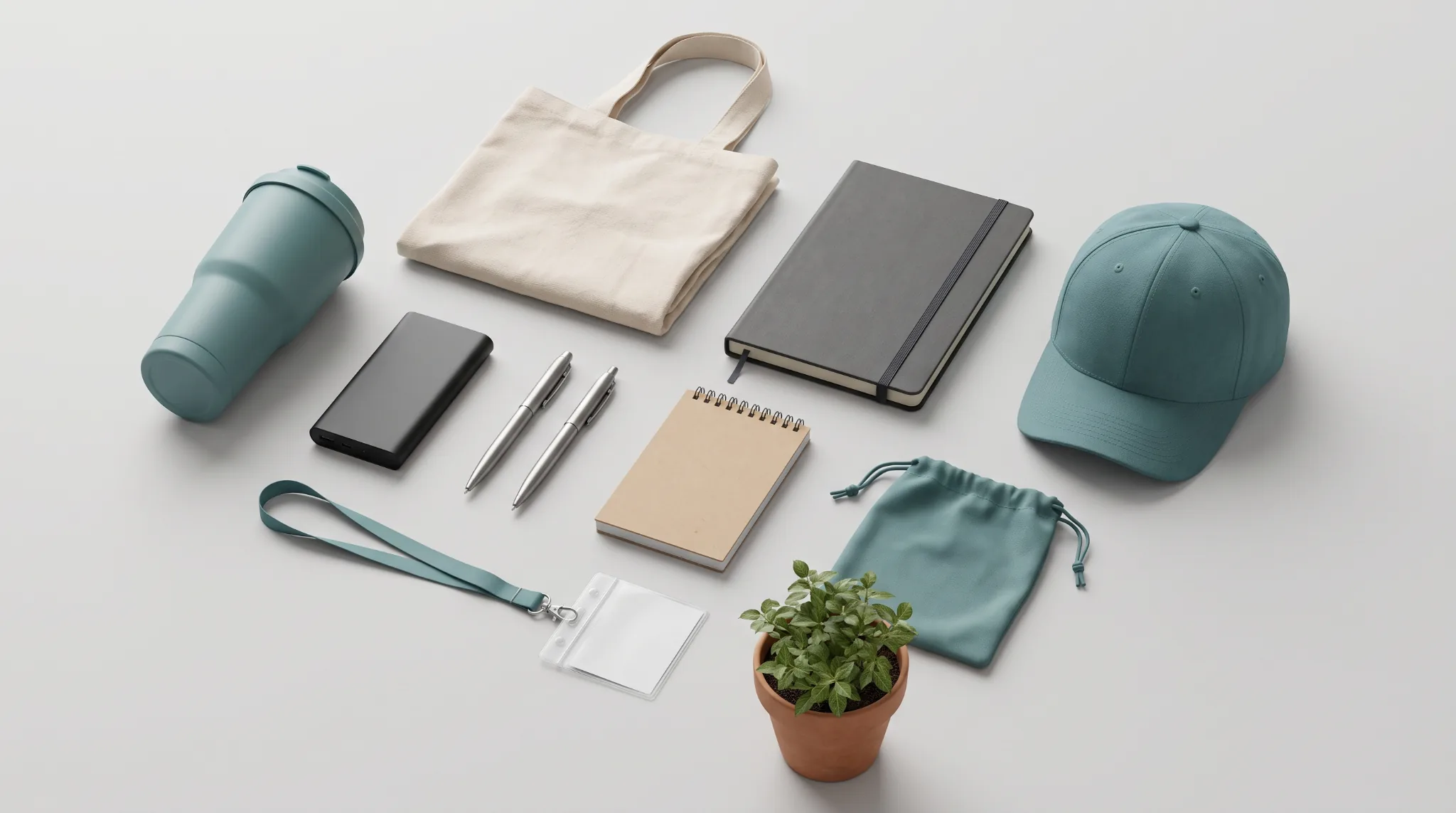
Industry never picks the product for you. What it does is rule out the wrong ones quickly, which is most of the job.
Six questions do that ruling out. Where does this person work? How do they dress? Do they travel? What safety rules apply to their site? What devices do they carry? And will they realistically have your item on them at a moment when someone else can see it?
Answer those, then layer on the campaign goal, the quantity, the budget and the in-hands date.
Here's the failure this prevents. A vacuum-insulated tumbler is close to a perfect item for a software company's onboarding kit. Give the same tumbler to a framing crew and it rides in a truck bed, picks up dents by week two, and has nowhere to sit while someone's on a ladder. Same product, same price, completely different outcome. Nothing about the tumbler changed. The environment did.
Quick Reference by Industry
Professional & Financial Services
Products that fit: Padfolios, metal pens, ceramic mugs, desk organizers
Confirm before ordering: Refill availability, imprint method on metal
Go deeper: Corporate gifts for client appreciation
Technology & Software
Products that fit: Power banks, cable organizers, backpacks, insulated bottles
Confirm before ordering: UL/ETL listing, FCC ID, lithium shipping route
Go deeper: Trade show giveaway ideas
Healthcare & Wellness
Products that fit: Totes, bottles, notebooks, staff apparel
Confirm before ordering: Facility branding policy, latex-free spec
Go deeper: Bulk custom apparel guide
Construction, Manufacturing & Field Teams
Products that fit: Insulated drinkware, outerwear, caps, tool bags For crews, our construction swag guide covers hi-vis and hard hat decals.
Confirm before ordering: ANSI/ISEA 107 class if hi-vis, extended sizing
Go deeper: Choosing promotional drinkware
Education, Nonprofits & Community Programs
Products that fit: Totes, pens, notebooks, bottles, event items
Confirm before ordering: CPSIA testing for under-12, Prop 65 for California
Go deeper: Eco-friendly promotional products
Hospitality, Real Estate & Travel
Products that fit: Welcome kits, umbrellas, travel organizers, drinkware
Confirm before ordering: Individual packaging, drop-ship address file
Go deeper: Employee welcome kit checklist
Promotional Products for Professional and Financial Services
These are meeting-driven rooms. Your item ends up on a conference table in front of somebody's client, which means finish beats features every time. Banks and credit unions get their own breakdown in our guide to bank promotional products.
Padfolios and desk accessories work here because they're already part of the ritual. Pens work too, but "good pen" means something specific in this segment. A metal barrel laser-engraves to a clean recessed mark that outlives the pen. Pad-print the same barrel and the logo starts flaking within a few months of pocket use. The engraving costs a bit more per unit and it decides whether the pen is a keeper or an embarrassment.
Check the refill before you commit. A surprising number of promotional metal pens take a proprietary cartridge nobody stocks, so the pen becomes a paperweight the day the ink runs out.
Keep drinkware restrained. A matte ceramic mug with a single-color mark reads as professional. A 40oz tumbler wrapped in full-color artwork does not, not in this room.
Promotional Products for Technology and Software Companies
Tech audiences are the most forgiving on style and the least forgiving on function. Nobody at a software company will comment on the color of a power bank. Everybody will notice it charges slowly.
Start with charging accessories, cable organizers and wireless chargers, then backpacks for hybrid teams and conference distribution.
Three verification steps matter more here than in any other segment, and none of them are optional.
Ask for the UL or ETL certificate on anything with a battery. Not a claim on a spec sheet, the actual certificate. Ask for the FCC ID on any wireless charger, and if the supplier can't produce one, move on. Then ask how the product ships. Lithium cells travel under UN38.3 rules, which restrict air freight and add hazmat handling at multiple points in the chain. Battery items routinely land later than a comparable non-battery product ordered the same day, and that gap is where programs miss their date. If you're already inside a tight window, a non-battery alternative on rush production will serve you better than a power bank that arrives after the event.
One more thing about this audience. Ambitious gadgets fail here more often than they succeed. A cable organizer that does one thing reliably outperforms a five-in-one charging hub with a setup process, because the hub gets opened once, found confusing, and shelved.
Promotional Products for Healthcare and Wellness Organizations
Two very different audiences share this heading, and they need different things.
Staff programs reward broad usefulness: bottles, totes, notebooks, and branded apparel that clears the facility's dress code. Confirm the branding policy before you shortlist anything wearable. Plenty of health systems restrict logo placement in clinical areas, and some prohibit vendor logos on staff apparel outright. Finding that out after the order is placed is an expensive lesson.
Patient-facing distribution is a separate problem. Think about who's actually receiving the item: age range, dexterity, and whether they're leaving a waiting room with one hand already full.
On antimicrobial and wellness claims, here's the pattern we run into constantly: a supplier markets a product with a health benefit, we ask for the current documentation supporting it, and it doesn't exist. That's why these programs usually work better with products that don't need the claim at all. A well-made bottle does the job without handing your marketing team a regulatory problem.
Promotional Products for Construction, Manufacturing and Field Teams
Durability is the entry requirement. Everything else is detail.
Insulated drinkware is the strongest performer in this segment by a wide margin. A double-wall tumbler with a secure lid survives a jobsite and gets used every day of the year, which is more than most promotional items manage in a month. Outerwear and caps carry the highest perceived value and are the items crews actually request by name. Tool bags and outdoor gear fill the middle of the range.
Now the question that comes up on nearly every one of these programs.
A branded safety-yellow shirt is not an ANSI/ISEA 107 garment. Those are different products with different requirements. If the site mandates Class 2 or Class 3 visibility, the item has to be certified to that standard or the crew can't wear it where it counts, and you've bought several hundred shirts that live in a closet. Promotional apparel is not a substitute for certified PPE. Any distributor who blurs that line is creating a liability that lands on you, not them. When a program genuinely needs rated garments, we source certified stock and hand over the documentation with the order.
Size the run generously. Field teams skew larger than office programs, and 2XL and 3XL usually carry an upcharge you want visible in the quote from day one rather than discovered at invoicing. Our bulk apparel guide covers size curve planning in more detail.
Promotional Products for Education, Nonprofits and Community Programs
Cost per person is the binding constraint here, and volume is usually high. That combination is exactly where a low unit price works in your favor instead of against you.
Totes, pens, notebooks, bottles and event items cover orientation, fundraising, donor recognition and community outreach without much overlap in what they're doing.
Two compliance items are worth knowing by name.
CPSIA governs anything intended for children twelve and under. It requires third-party testing and a Children's Product Certificate, and not every promotional supplier maintains tested stock. That single requirement narrows the field considerably for K-8 programs, which is why it's better to establish it at the shortlist stage than after you've fallen in love with a product.
Prop 65 applies to anything distributed in California and governs warning labels for listed chemicals. It touches more categories than most buyers expect, including certain vinyl and PVC items.
If sustainability is part of the message, the claim has to match the product. Recycled and eco-friendly options are worth using. Just confirm the certification exists before it goes in the press release.
Promotional Products for Hospitality, Real Estate and Travel
This is the one segment where presentation isn't a finishing touch. It's part of the product. Agents have a different gift cycle, so see open house and closing gifts for real estate agents.
Travel organizers, umbrellas, drinkware, notebooks and curated welcome kits all perform well. But an item that arrives in a plain poly bag undoes most of the effect you paid for, so decide packaging and fulfillment during product selection rather than after.
Kitting, custom boxes and inserts are quoted separately and add production time. If items go to individual addresses instead of one location, you'll need a clean address file and a per-address handling charge in the quote. That line item surprises people more often than any other.
Understated decoration works better here than anywhere else on this list. A closing gift that looks like a closing gift outperforms one that looks like advertising.
How to Build Your Shortlist
Whether you need custom promo products for one event or custom company promotional items for every office, write down six things before you compare a single product: audience, setting, the function the item has to perform, restrictions or certifications, budget per person, and in-hands date.
Then compare two or three candidates on delivered cost, not unit price. Delivered cost means the item plus decoration, setup, packaging and freight. Comparing unit prices alone will point you at the wrong product more often than it points you at the right one, and it's the single most common mistake in promotional buying. If you're building a business case, our ROI guide covers how to frame the spend.
Request samples for anything high-visibility. A tumbler feels different in your hand than it looks in a catalog photo, and a sample is cheap insurance on a four-figure order. For events, pre-built giveaway kits are worth quoting.
Ready to narrow it down? Browse promotional products by category, check current deals, or tell us about your program and we'll build a focused shortlist with delivered pricing.
Frequently Asked Questions
Which promotional products work best for healthcare organizations? Broadly useful staff items perform best: bottles, totes, notebooks and apparel that meets the facility dress code. Confirm the organization's branding policy before selecting anything worn in clinical areas, and avoid products that depend on health or antimicrobial claims unless the supplier can produce current documentation.
Can promotional apparel be used as high-visibility safety gear? No. Safety-colored promotional apparel is not equivalent to an ANSI/ISEA 107 certified garment. If a jobsite requires Class 2 or Class 3 visibility, the item must be certified to that standard. Certified hi-vis is available as a separate sourcing path with documentation provided.
What certifications matter for promotional products given to children? CPSIA applies to products intended for children twelve and under, requiring third-party testing and a Children's Product Certificate. Prop 65 applies separately to items distributed in California. Confirm both at the shortlist stage, since not every supplier stocks CPSIA-tested product.
Why do tech promotional products take longer to produce? Anything containing a lithium cell ships under UN38.3 regulations, which restrict air freight and add hazmat handling. That routinely extends the timeline compared to a non-battery item ordered the same day. For tight deadlines, a non-battery alternative is usually the safer choice.
How should I compare promotional product quotes? Compare delivered cost rather than unit price. A complete quote includes the item, decoration, setup charges, additional imprint colors or locations, packaging and freight. Two products with similar unit prices can differ substantially once those charges are included. Our FAQ covers the ordering process in more detail.