Promotional Products ROI Guide: How to Measure What Actually Works
A tumbler can be the right product and still be a bad campaign.
That happens when nobody wrote down what “worked” meant before the order left. The catalog price looked fine. The boxes arrived. Someone later asked for ROI and the only number on the table was unit cost versus a revenue number that also had a salesperson, an email sequence, and a renewal date attached to it.
Promotional products can start a booth conversation, land a welcome kit on a desk, or sit in a client’s bag for a year. Those are different jobs. They do not share one scoreboard.
This guide is the measurement process we use with buyers across the USA. It covers how to set the outcome first, how to cost the whole program, which metric fits which campaign, when a percentage ROI is honest, and what to write down before anyone picks a color.
Product fit lives elsewhere. Use the drinkware guide or the top 25 products filter when you are still choosing the item. Use how to order promotional products when the problem is the calendar. Stay here when the question is whether the spend did the job.
The question that should come first
What should a recipient do after they have the piece?
Stop and talk at a booth
Show up on day one with the tools they need
Take a meeting or send a referral
Wear or carry the mark in a place other people can see it
Reorder approved gear without a new fire drill
Write that action down. Then pick one primary metric. Secondary notes are fine. Five “also important” KPIs are how teams argue after the fact.
If you cannot name the action, you are not ready to measure. You are ready to browse.
Use three scoreboards, not one percentage
Most ROI pages force every kit into revenue. That is how onboarding programs get called failures and booth bags get called wins.
Campaign job | Primary metric | Useful secondary | Do not treat as success |
|---|---|---|---|
Trade show or conference | Qualified conversations or meetings booked | Cost per meeting, pipeline that is still alive 30 days later | Badge scans and “booth visits” |
Client thank-you | Renewal talk, referral, or account reply you can point to | Recipient feedback, repeat order from that account | “They posted a photo” with no follow-up |
New-hire kit | Kits delivered complete and on time | Day-one feedback, exchange rate on apparel | Number of items in the box |
Direct mail | Delivered pieces that produced a visit, reply, or quote | Cost per response | Mail drop count |
Company store or refill program | Reorders on the core shelf, fewer side emails | Fill rate on real sizes | Launch-week order spike |
Awareness | Repeat use you can observe or ask about | Share of recipients who still have the item at 90 days | A made-up impression total |
That table is the page. Everything below is how to fill it in without lying to yourself.
Booth tactics stay on trade show giveaway ideas. First-week contents stay on the employee welcome kit checklist. Gift tone stays on client appreciation gifts. This page only scores the program after those choices are made.
Cost the program, not the tile
The $4.50 on the product page is a comparison tool. It is not the campaign.
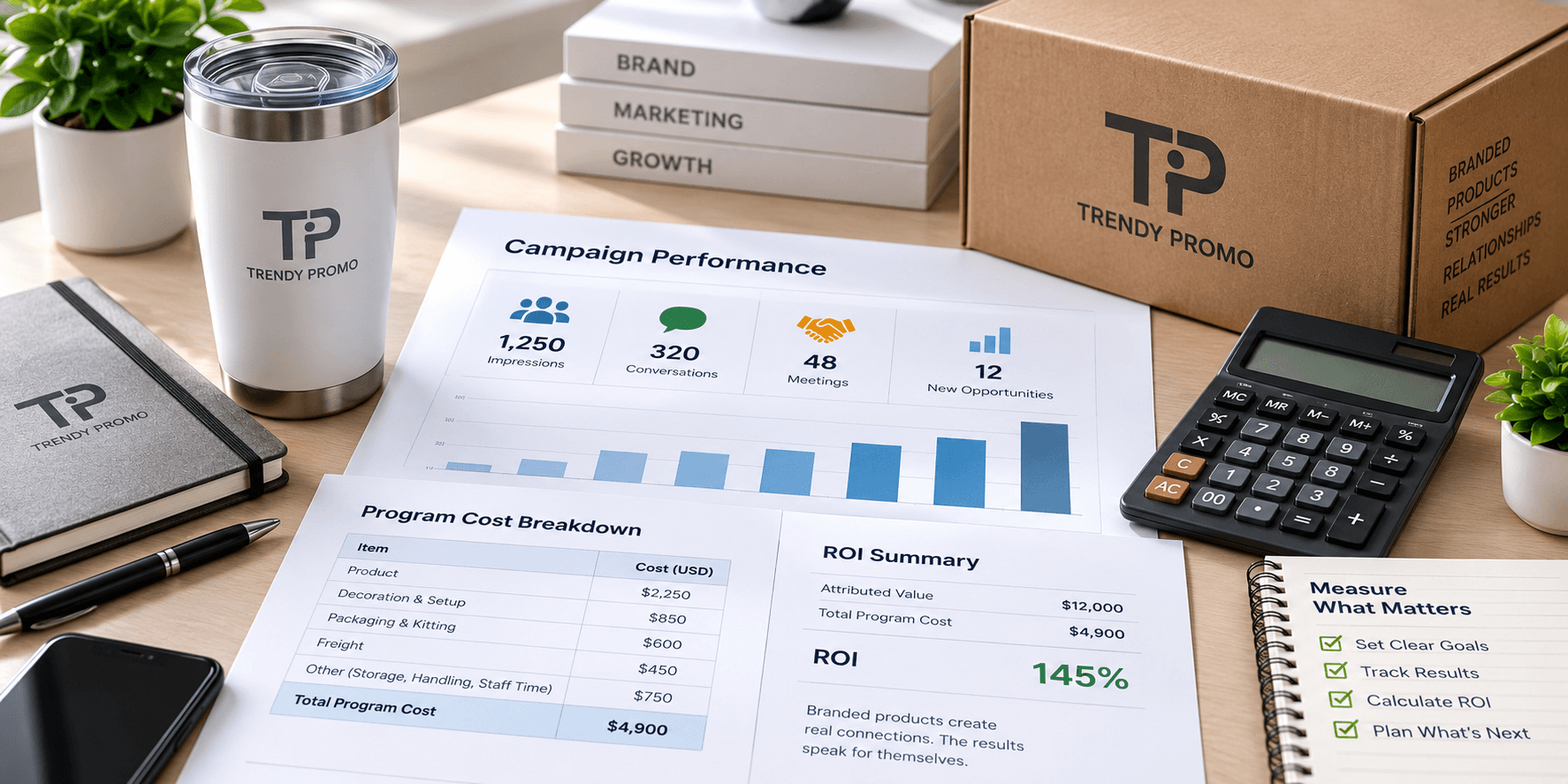
Delivered program cost usually includes some mix of:
Product
Decoration and setup
Proof and sample
Packaging or kitting
Freight
Split ship-tos
Storage
Booth or event handling
Replacement units
Staff time to collect sizes, addresses, and approvals
If you skip freight and kitting, every later ROI number is theater.
Work backward from quantity and spend with the budget calculator before you fall in love with a SKU. Reused artwork or leftover packaging from last year belongs in the notes so this campaign is not charged for work it did not do.
When a percentage ROI is honest
Use the simple formula only when you can defend the revenue line.
ROI = (Attributed value - Total program cost) / Total program cost x 100
Example: the program costs $5,000. You can reasonably tie $12,000 in closed revenue to that campaign.
($12,000 - $5,000) / $5,000 x 100 = 140%
The hard part is the $12,000.
A client who received a gift also got a Q4 email, a check-in call, and a contract that was already in motion. Credit the gift as influenced unless you have a clean reason to call it generated. Conservative reporting survives a finance review. Inflated reporting does not.
If you cannot separate the gift from the rest of the motion, do not publish a percentage. Publish cost per meeting, cost per delivered kit, or cost per qualified lead. Those numbers are smaller. They are also true.
Impression math is not a measurement plan
Industry studies are useful context. They are not your campaign.
An average lifetime impression figure does not tell you whether your tote left the building or sat under a tablecloth. Do not put that average in a deck as if you counted it.
Awareness is measurable when you ask a short question later (still have it, still use it) or when you can see repeat use (the bottle on the weekly Zoom, the cap on the jobsite). If you will not do that work, do not claim awareness ROI. Claim distribution and stop.
Give the physical piece a next step you can count
Measurement gets easier when the item points somewhere specific.
Good next steps:
A landing page built for that event or list, not the homepage
A code on the card that sales can see in the CRM
A calendar link used only for booth follow-up
A store login for employees who need a second piece
Bad next steps:
A QR code that dies once it is printed on a curve
A form that asks for a home address you will not use
A “learn more” button with no campaign tag
Tell people what you collect. Collect only what the follow-up needs. A trackable gift that feels like surveillance is a lost gift.
Count the waste. It is part of ROI.
Returned kits, leftover cartons, bad addresses, lids that failed, QR codes that did not scan, and freight surprises are not footnotes. They change the real cost per successful outcome.
Write down:
Pieces ordered
Pieces that reached the intended person
Pieces damaged or exchanged
Pieces still in a closet 60 days later
Unplanned freight or rush fees
If you bought 500 pieces but only 350 reached recipients in usable condition, calculate your cost per successful delivery against those 350, and record the other 150 as waste or loss. The next brief should say why.
Ordering mistakes that create that waste (late lists, proof delays, rush on the wrong SKU) belong in how to order promotional products. Fix the process there. Score the damage here.
Two campaigns, same product, different verdict
Campaign A hands a bottle to everyone who makes eye contact. 500 touches. 10 real conversations. For more ways to score a campaign, see seven metrics that go beyond sales.
Campaign B hands the same bottle after a two-minute product talk. 250 touches. 40 conversations. 12 meetings.
If the goal was pipeline, B won. A only won if the goal was “look busy.” The product did not change. The rule for who received it did.
That is why ROI starts with the handoff rule, not the catalog photo.
Write the measurement brief before the quote
Keep it on one page.
Objective in one sentence
Who receives it
Dates
Delivered budget
Quantity
Primary metric
What you will call attributed vs influenced
Where the numbers will come from
Review date
That brief stops the after-party move where someone picks the friendliest number. Share it with whoever approves spend.
If the program is a standing shelf instead of one drop, judge it as a company store: reorders, size fill rate, and whether side emails actually stopped. Launch-week orders are not the score.
What to send us if you want the spend scored
Put objective, audience, quantity, delivered budget, in-hands date, and the primary metric in a concierge request. We will shortlist products that can hit the date and tell you which numbers are realistic to collect. Policy questions on proofs, minimums, and rush sit on the FAQ. If you need a trackable starting point, event giveaway kits, logo tumblers and printed tote bags are easy to tie to a code or landing page.
Do not start with “what is trending.” Start with the action, the delivered cost, and the one number you will trust when the boxes are gone.
Frequently asked questions
What is promotional products ROI?
It is whether the program did the job you named, at the delivered cost you actually paid. Sometimes that is a revenue percentage. Often it is cost per meeting, cost per delivered kit, or cost per reply.
How do you calculate it?
When revenue is clean: (attributed value - program cost) / program cost x 100. When revenue is messy, use a unit cost against the outcome you can count.
Should I use industry impression averages?
As background, yes. As your result, no. Count what happened to your pieces.
How long should I wait before judging a client gift?
Long enough for a real follow-up cycle. Set the review date before the campaign launches. A week is too short for a renewal. A year with no note in the account file is too long to keep calling it pipeline.
What if the campaign was never meant to make money this quarter?
Measure operations: on-time delivery, completion rate, exchanges, leftover inventory. Forcing a percentage hides the useful data.
Where do I start if I only have a budget?
Set the outcome and the review date. Run quantity against spend in the budget calculator. Then choose the product. Measurement first keeps the catalog from picking the metric for you.