A company store is not a nicer catalog. It is a standing rule set: which items are approved, who can order them, who pays, and where they ship. If you do not need those rules, you do not need a store. You need a quote.
We build these for HR, internal comms, and distributed teams that are tired of a new art proof every time someone wants a hoodie. We also tell people not to open one. This page is that filter, rather than another “what is a company store” definition.
A store is worth building when
You have recurring demand, not a single event. New hires every month. Field teams that wear through caps. Offices that keep asking for the same bottle.
You have more than one buyer. If five managers each run their own merch order, the logo drifts and the unit price gets worse.
You need a budget control that is not “email us and hope.” Credits, department codes, or a locked assortment stop surprise invoices.
You ship to homes and offices, not one receiving dock. Individual addresses are where one-off programs break. A store makes that the default. The same problem shows up on welcome kits and client gifts.
A store is just a catalog when
You need 75 shirts for one offsite. That is a bulk apparel order. Use the bulk custom apparel guide.
You need a year-end client gift. That is a gated list and a pack-out date, not a public shelf.
Nobody will come back for a second item. A store with no reorder is a website you will forget to update.
You want 80 SKUs “so people have choice.” Choice without a size run and a fulfillment plan is a closet. Twelve to twenty live items beat eighty every time. A starter store can be as small as two polo styles and one hoodie.
Company store vs one-off vs kit program
One-off order: one SKU, one date, one ship-to. Fast. Correct for events and most trade show giveaways.
Kit program: a fixed box sent on day one, an anniversary, or after a closed deal. Correct when everyone should get the same thing.
Online company store: an approved shelf employees (and sometimes partners) pull from all year. Correct when demand is messy and ongoing.
Most companies need two of the three. Almost nobody needs all three in month one. Start with kits plus a short store, or a store plus a one-off event buy. Do not launch a portal to solve a single offsite.
Who pays
Company-paid credits. Best for onboarding and recognition. You control the ceiling.
Card or payroll buy-in. Best when people want extras above the credit.
Mix. Credit covers the core (shirt, bottle). They pay the difference on a jacket.
Pick this before you pick products. A $12 cap in a “free store” disappears in a week. The same cap at $18 buy-in sits. Price is a filter.
What belongs on the shelf
Put items on the store that survive daily use and do not need a new compliance conversation every quarter.
Core set for most employee stores:
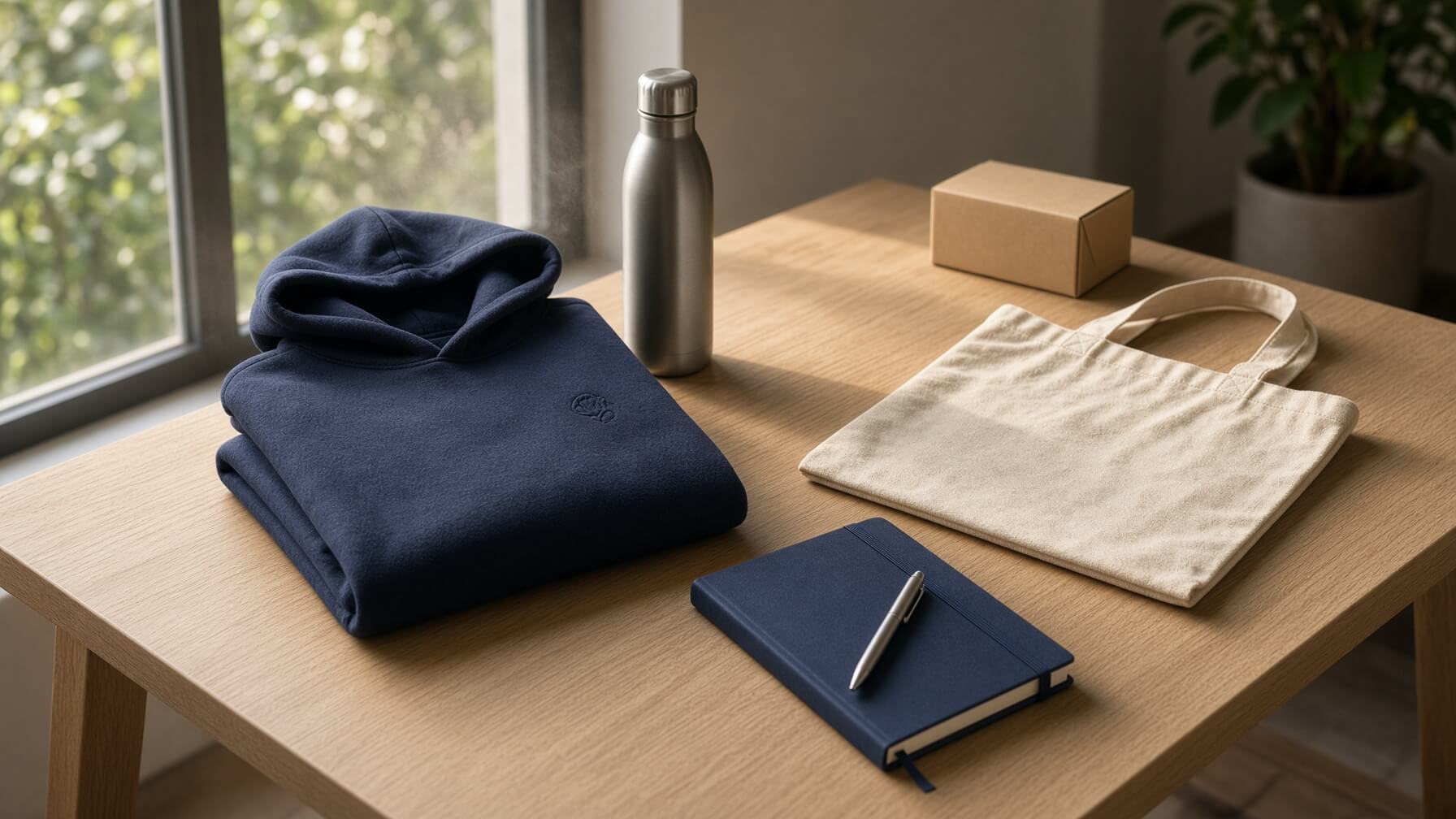
Apparel: one tee or polo, one mid-layer, one cap. Size the run like a field program: more 2XL and 3XL than an office guess, and show the upcharge in the store price.
Drinkware: one compact bottle or tumbler, restrained mark. Use the drinkware buying guide.
Bags: one tote or backpack people will carry, not a thin show bag.
Desk: notebook and a pen that takes a refill you can actually buy.
Optional tech: cable kit or charging pad. Power banks only if UL or ETL is on file and you accept UN38.3 freight rules. That check is in the industry buying guide.
Leave off the shelf
Safety-yellow promotional tees sold as hi-vis. They are not ANSI/ISEA 107. If the site needs Class 2 or Class 3, that is certified stock with paperwork, not a store tile.
Anything with a health or antimicrobial claim you cannot document.
Food, unless someone owns expiry and summer freight.
A fifth colorway of the same shirt “for fun.” That is inventory you will discount later.
Industry still rules products out. A hospital store and a construction store should not share an assortment.
Brand rules before the first SKU
One current logo file. One color palette. One decoration standard: where the mark sits on a chest, a cap, a bottle.
Who can upload art? Almost never “anyone with a login.”
What happens when marketing changes the mark? Old inventory needs a kill date, not a quiet leftover bin.
A store without those rules becomes five departments printing five versions of the same name.
Fulfillment is the product
Pick one model and write it on the brief.
Warehouse a short list. Faster on core sizes. You own leftover risk.
Decorate on demand. Less leftover. Slower on apparel.
Hybrid. Warehouse the top three SKUs. On-demand everything else.
Home delivery needs a clean address book and a handling line. That same cost can surprise buyers planning kit programs. Do not promise two-day on a lithium item or a custom-color jacket you have never stocked.
How to judge whether the store worked
Do not score it on launch-week orders.
Watch fill rate on core sizes, return rate, SKUs that have not moved in 90 days, and how often someone still emails for a “quick side order” that should have been on the shelf. If side orders never stop, the assortment is wrong or the login is too painful.
Frame the spend like any other program in the ROI guide: cost to stand it up, cost to keep it current, and whether it replaced chaos.
How to brief us
Send headcount, locations, who pays, must-have items, in-hands date for launch inventory, and any site rules (branding policy, hi-vis, no vendor marks in clinic). We will tell you if a store, a kit, or a one-off is the cheaper correct tool.
Contact us or send a concierge request. The FAQ answer on company stores is the short version of this page. Remote-heavy teams should compare a store with direct-to-home kit shipping, and SaaS teams can borrow from our SaaS merch playbook.
Frequently Asked Questions
What is an online company store for employees?
A private, approved shelf of branded items that employees (and sometimes partners) can order without a new quote each time. Credits, card, or both.
How many products should we launch with?
Twelve to twenty. Add only what sells through. Do not launch with a wall of colorways.
Can clients use the same store?
Sometimes a gated second view. Do not put employee tees and client gifts on one public grid. Different job, different finish.
Do we have to stock everything?
No. Hybrid is the usual adult answer: warehouse what runs every week, decorate the rest to order.
Is a company store cheaper than one-off orders?
Per unit, often, once volume repeats. Standup cost is real. If demand is one event a year, one-off wins.
How is this different from a public swag shop?
A public shop is marketing. An employee store is procurement with a login. If anyone on the internet can buy the hoodie, you have a different problem involving brand control, returns, and sizing, and you should say so in the brief.