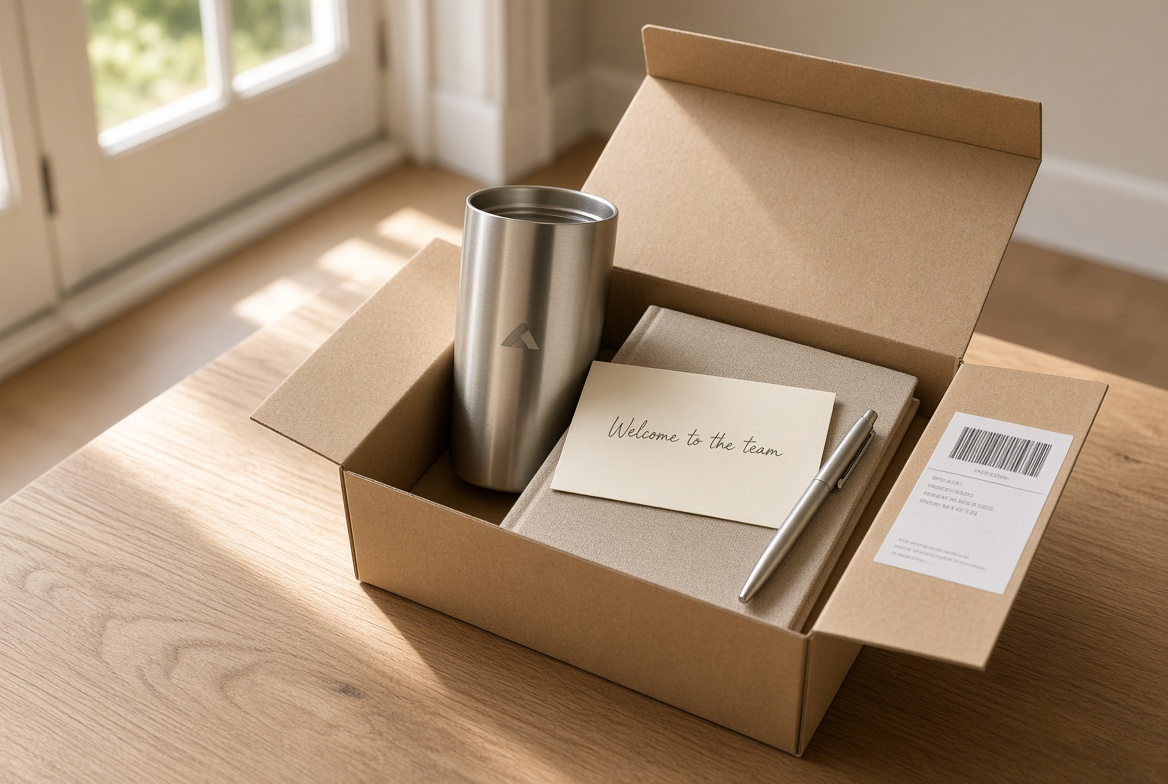
How to Ship Swag to Remote Teams
A pallet to one office is a freight job. Eighty boxes to eighty porches is a different job. Same logo. Same tumbler. Completely different cost, calendar, and failure rate.
This page is the shipping plan. What belongs in the box lives on the employee welcome kit checklist. What belongs on a standing shelf lives on when a company store is worth building. How a normal decorated order moves from proof to dock lives on how to order promotional products. Use those when you need them. Stay here when the problem is getting branded gear to people who do not share a mailroom.
Start with the ship pattern, not the hoodie
Write four facts before you open a catalog:
Who gets something, and who does not (employees only, contractors, interns, people on leave).
Where it has to land (home, a coworking desk, a field truck, a handful of offices plus homes).
Whether everyone gets the same box or they pick size and item.
The in-hands date. That is the day the box is on their stoop, not the day a label prints.
If those four answers are fuzzy, the quote will be fuzzy. Split ship-tos, residential delivery, and late address lists are the usual reasons a simple merch order misses a start date.
Trendy Promo ships nationwide. Most decorated orders move UPS or FedEx Ground from the decorating supplier, not from a public counter in Chicago. Split shipments to multiple addresses are normal if you put every ship-to on the quote. International is not a standard service. If you have people outside the U.S., ask first. We will only say yes when the route is reliable.
Three ways to get swag to a distributed team
Pick the model that matches demand. Do not pick the model a software homepage is selling this month. Whatever the model, pick items that pass the useful-at-home test.
One-off drop-ship. You approve one SKU (or a short kit), we decorate, and cartons go straight to a list of homes. Correct when the moment is shared: a kickoff, a year-end gift, one new-hire class with a fixed start week. Fast to set up. Painful if sizes are wrong or the address file is dirty.
Kit program. A fixed box ships when something happens: offer accepted, day one, 90 days, five years. Correct when every person should open the same thing. You still need sizes, addresses, and a pack-out that survives a porch. The welcome kit checklist is the contents brief. This page is how that box travels.
Company store. An approved shelf. People choose size and ship-to at checkout. Correct when hiring is continuous, managers keep asking for the same bottle, or you are tired of a new proof every time someone wants a hoodie. The store is a rule set, not a website. Read when a company store is worth it before you build one for a single holiday drop.
Most teams need two of the three. A kit for day one plus a short store for extras is the common pair. A giant one-time dump to every home address is how you end up with leftover 40 oz tumblers in a storage unit.
What actually costs money on a remote send
Catalog unit price is the least useful number on the quote. For home delivery, the line that moves is delivered cost:
Product
Decoration and setup
Individual shippers, inserts, and kitting
Per-address handling
Ground freight (weight, carton size, zone, residential surcharge)
A few replacements and size exchanges
Exception work when a label comes back undeliverable as addressed
A compact bottle that looks cheap in bulk can be expensive once it sits in its own carton and rides residential Ground to a third-floor walk-up. A midweight tee is the opposite: light, compressible, easy to pack. That is why you quote the ship pattern before you fall in love with a SKU.
Use the budget calculator to keep the conversation on delivered dollars. Then confirm the live freight on the actual addresses. Averages from someone else’s blog are not your invoice.
Products that survive a porch (and products that do not)
Remote freight is rougher than an office receiving dock. Nobody signs at 2 p.m. and walks the carton to a mail slot. The box sits. It gets stacked. It gets rained on.
Usually travel well
Compact insulated bottles and tumblers with a closed lid and their own shipper. Spec them in the drinkware guide and browse custom drinkware. Skip glass and skip anything that dents in a thin mailer.
Notebooks and a pen that takes a drugstore refill. Small mark. Lives on a desk the first week. See office and desk.
One apparel piece you can size: tee, polo, cap, quarter-zip, hoodie. Folded, polybagged, with a size chart in the box. Size runs and exchanges live in the bulk custom apparel guide. Shop apparel after the exchange plan exists.
One bag people will actually carry. A structured tote or a laptop-friendly backpack beats a thin show tote. Bags and totes.
Simple tech that does one job: a short cable kit or a charging pad with documented specs. Tech and electronics.
Usually cause trouble
Ceramic mugs and glass without a real pack-out. They look generous in a photo. They arrive in pieces. If you still want a mug, budget extra packaging and replacement units. The drinkware guide flags that for home delivery.
40 oz drinkware. Dimensional weight and cupboard space both punish you.
Power banks and other lithium pieces on a tight date. Battery items often need extra paperwork and can be blocked from air. A power bank ordered the same day as a tumbler often lands later. Details on custom power banks and in the FAQ. If the start date is close, pick a non-battery piece.
Food through summer routes with no expiry or allergy plan.
Three shirts in three colors so they have a choice. Choice without sizes is waste. Choice belongs in a store, not in a surprise box.
SaaS and other desk-heavy teams run into the same freight rules as everyone else. Camera-friendly hoodies and compact bottles still have to fit a carton. The product filter is on branded merch for SaaS companies. The ship filter is here.
Collect addresses like fulfillment data, not like an HR spreadsheet
Home addresses are personal. Treat them that way.
Do not email a raw sheet of home addresses to a vendor list, a manager thread, or a shared drive that lives forever. Collect only what the carton needs: name, street, apartment or unit, city, state, ZIP, phone for carrier exceptions, and size if apparel is in the box.
Three collection methods that work:
Recipient enters the address at claim or checkout. Best for stores and for any program where people pick a size. The address is current because they typed it today.
A short form tied to that shipment. Best for a one-time kit. Close the form a few days before pack-out. Do not reuse last October’s file for a December gift. People move.
A clean list you already maintain, checked once. Only if someone owns that list and will confirm units, ZIP codes, and PO Box rules before the proof is approved.
Lock the file before you approve art. Eighty ship-tos is a data problem. Adding four names after production starts is how you get a second freight bill and a late carton.
Watch the usual address failures: missing apartment numbers, office-park suites used as home addresses, nicknames that do not match the doorbell, rural routes, and hold-at-location notes that never make the label. Gated buildings and apartment lockers often need a phone number on the label. Ask for it up front.
PO Boxes are a separate conversation. Many promotional cartons will not go through a PO Box cleanly. If someone only has a box, get a physical street address or hold that one order.
Timeline: two clocks, not one
Finish this list before anyone approves the e-proof:
Brief, quantity, budget, and in-hands date
Product shortlist and delivered-cost quote
Artwork cleanup
Address file
Apparel sizes, if a garment is in the box
The FAQ clock starts after that. Plan on 2 to 4 calendar weeks for a standard popular product, from approved proof and cleared payment to delivery. Production is typically 5 to 15 business days after those two items are in. Ground freight adds about 2 to 7 business days depending on the ship-to.
That production and shipping window still has to cover:
Kitting and individual cartons
Residential delivery and first-attempt misses
Alaska, Hawaii, and other off-mainland ZIPs (longer transit, sometimes a surcharge)
Battery documentation and handling, if you kept a power bank on the order
The how to order page treats the pre-proof stretch as its own planning step. If you start counting at “we should send hoodies,” you will eat the brief time and still need the 2 to 4 weeks after approval.
Trigger a new-hire kit when the offer is signed, not on Monday of week one. If you wait for day one, the box becomes a week-three apology.
Rush exists on some items. It is a premium, and it still needs transit after the factory. 24-hour rush promotional products explains what is actually possible in a day. Multi-address kits and lithium tech rarely belong in that conversation.
We do not issue a blanket guaranteed-by date on every order. We control sourcing, artwork, and the supplier handoff. We do not control weather or a carrier exception. Build a 3 to 5 business day buffer into the in-hands date and you will need fewer emergency overnight labels.
Hybrid teams: one program, two docks
If half the company sits in two offices and half sits at home, do not force every unit through the expensive path.
Ship a bulk carton to each office that has a real receiving person. Drop-ship the remote and hybrid people who will not be in that building the week the freight lands. Same SKU is fine. Same packing is not required. Office freight can be a master carton. Home freight needs a gift-like shipper that still looks decent after a ride on a truck.
Do not leave remote people as a pickup-at-reception afterthought. That is how you get Slack photos from HQ and silence from everyone else. Recognition gifts have the same split. The product ideas are on corporate gifts for employees. The freight line is still this page.
Pack-out is part of the product
A kit that looks generous on a conference table can look cheap when the note is buried and the tumbler has scuffed the notebook.
Before you release the full kit order, test the pack-out when the schedule allows:
Build one live box with the real products, the real insert, and the real shipper.
Mail it to yourself or to someone who will open it on a porch, not at a desk.
Check whether the note is the first thing they see.
Check whether anything moves enough to scratch a print or dent a lid.
Check whether the carton still reads as a gift after handling.
If the test box fails, change the pack-out. Do not hope the next 59 will behave.
Put a simple care or size card in apparel cartons. Put a one-line note in kits: if this arrived damaged, photograph the box and write us. Claims go faster when the carton still exists. The FAQ covers damaged freight: photograph the outer carton and the inner damage, keep the packing, and email claims@trendypromo.com within 5 business days.
Exceptions people forget until the tracking stops
Undeliverable as addressed. Missing or incorrect unit numbers can cause returns. The carton comes back. You pay freight twice if you reprint the label without fixing the file.
Refused or unclaimed. Someone is traveling. Hold dates help. A phone number on the label helps more.
Signature required. Rarely worth it on a modest kit. It may cause a missed delivery when nobody is home to sign.
Returns and exchanges. Apparel needs a plan before the first box leaves. If you cannot exchange it, do not put it in a surprise kit. Put it on the store.
Tax and gift reporting. That is an HR and finance question, not a decoration question. Flag high-value sends early so nobody is surprised in January.
International teammates. Not default. Customs, duties, and restricted materials make promo freight hard to promise overseas. Ask. If we cannot do it cleanly, we will say so and you can run a local buy for that person instead of stalling the U.S. list.
How to brief the order so freight is in the first quote
Send one note. Do not drip addresses in Slack for two weeks.
Headcount and who is eligible
Office vs remote vs field mix
One box for everyone, or choice of size and item
In-hands date with buffer
Budget per person delivered, including freight
Apparel yes or no, and whether you can collect sizes
Battery or food constraints
Ship-to pattern: one dock, many homes, or both
Logo file and any no-vendor-mark rules
Request a quote. We will tell you whether a drop-ship, a kit, or a store is the cheaper correct tool, then shortlist items that can actually make the date. For home delivery, sturdy items like stainless tumblers travel better than glass, and branded gift bags help the unboxing feel finished.
Frequently asked questions
Can you ship promotional products to each employee’s home?
Yes. Split shipments and residential addresses are normal. Put every ship-to on the quote so freight and handling show up before you approve the proof.
Do I have to collect home addresses myself?
Not if people order from a company store or claim a kit through a form. They enter the address when they pick the item. For a batch drop-ship, someone still has to produce a clean file before production starts.
How long does remote swag take?
Once the e-proof is approved and payment has cleared, plan 2 to 4 calendar weeks for a standard popular product to reach the recipient. That window is production (often 5 to 15 business days) plus Ground (often 2 to 7). Collecting sizes and addresses, cleaning artwork, and approving the proof sit before that clock. Kits to many homes and battery products sit on the long side of the range.
Is it cheaper to ship everything to HQ and forward it?
Compare both delivered quotes. Direct-to-home looks expensive until you add a second set of labels, staff time, and the week the carton sits in a conference room. Forwarding can still win for a small team that already runs a mailroom and only has a handful of remote people. It usually loses once the list is long or nobody owns the forwarding step.
What should I avoid mailing to remote staff?
Glass without a pack-out, oversized drinkware, undocumented lithium on a short calendar, unsized apparel, and food with no allergy or heat plan. The gift ideas page and the welcome kit checklist both list quieter options that travel.
Can remote and office employees get the same item?
Yes. Quote two freight paths. Keep the mark and the color consistent so nobody feels like they got the leftover version.