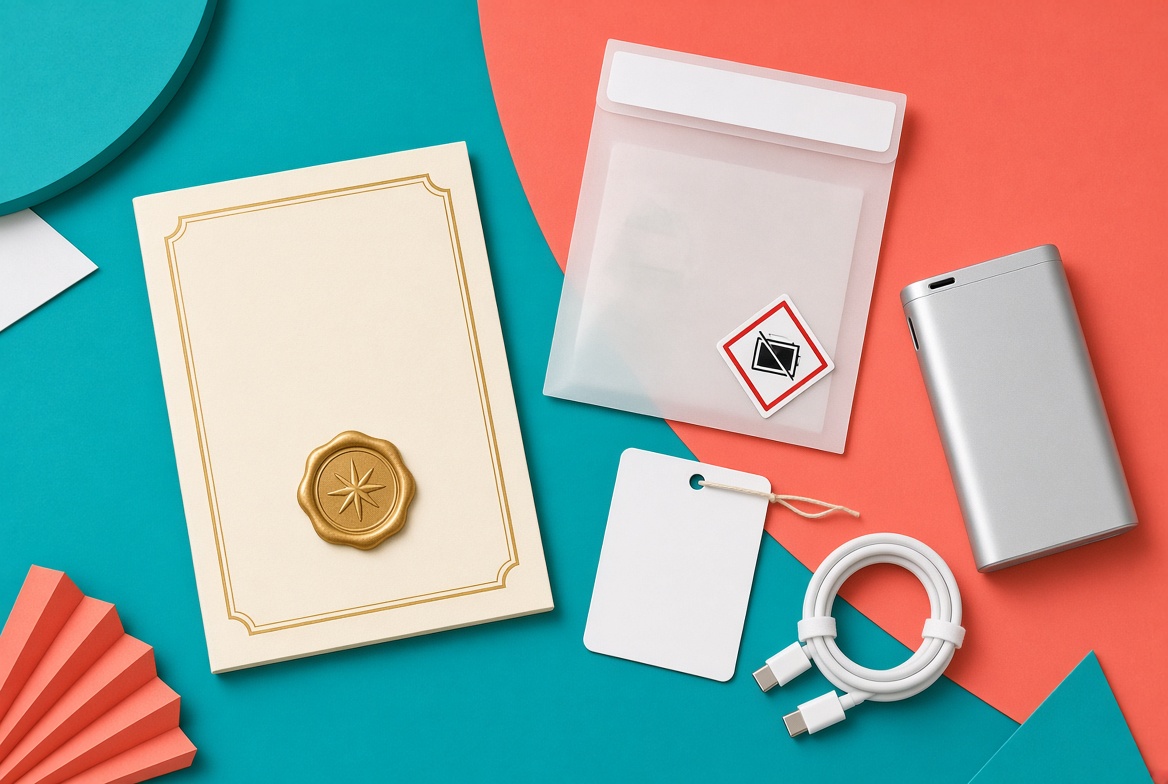
A custom power bank is the promotional product people ask for and the one that shows up late.
Factory pages sell FOB price and MOQ. Catalog pages sell glow shells and free setup. The U.S. buyer problem is different. Will this branded portable charger charge a current phone, can you file the safety paper for the exact model, and will the carton reach the city on the invite?
The case against the wrong custom logo power bank is short: no verifiable listing for this model, too little usable capacity, and a lithium shipment that cannot use the service on the event calendar.
One-line lithium warnings already live on the industry guide, the trade-show giveaway list, the client-gift guide, and the welcome-kit checklist. Those pages stay short on purpose. This post owns capacity, certificates, ports, and the calendar.
Capacities, documentation, and dollar figures below are planning ranges from common U.S. supplier programs. The documentation for the exact model and the written quote control.
What you are actually buying
A promotional power bank is a lithium-ion or Li-polymer pack in a branded shell, with output ports, and a decoration method that still reads after a year in a bag.
Advertised mAh is the cell rating, not what reaches the device. Conversion loss is real. A 10,000 mAh bank does not pour 10,000 mAh into a phone. Use capacity to compare models inside one line, not across every catalog on the internet.
Capacity | What it usually does | Who it fits | Planning delivered each, decorated, mid quantity |
|---|---|---|---|
2,200 to 3,600 mAh | Limited emergency top-off | High-volume programs where price matters most | $6 to $10 |
5,000 mAh | Substantial phone top-off, sometimes close to one charge | Welcome kits, most reserved booth gifts | $10 to $16 |
10,000 mAh | Phone plus a buffer | Client gifts, field techs, travel | $14 to $24 |
20,000 mAh | Heavy travel | Small executive lists, not a booth pile | $22 to $40 |
Sweet spot for most U.S. programs: 5,000 to 10,000 mAh, USB-C input and output, one clean imprint, metal or decent textured plastic. Below 5,000 mAh many models are only an emergency top-off. At 20,000 mAh and above, size, weight, price, and freight have to earn the extra cell.
The three documents that matter
Safety documentation for the finished power bank. Ask whether the exact model has been evaluated to UL 2056 by a nationally recognized testing laboratory, such as UL Solutions or Intertek. UL 2056 is the standard. UL and ETL are certification marks, not interchangeable names for the standard. Request listing or certification paperwork that matches the manufacturer and model number. A sell-sheet claim is not enough.
UN38.3 test summary. Lithium cells and batteries offered for transport must have passed the applicable tests in Section 38.3 of the UN Manual of Tests and Criteria. U.S. DOT guidance says manufacturers must make lithium-battery test summaries available on request. Ask for the summary for the exact battery design. Passing those tests does not guarantee air service. Packaging, watt-hours, battery configuration, quantity, marks, labels, documentation, carrier policy, and the shipping lane still control.
FCC equipment authorization. Wireless-charging models should show the applicable FCC authorization or compliance route. Do not assume every model must display an FCC ID, or that a Qi logo proves FCC compliance. Ask for paperwork tied to the exact model.
Cable quality is the failure people remember. If the SKU includes a cable, ask whether it carries the same warranty and replacement policy as the power bank. Send production art that matches artwork file requirements.
Why the date slips
Lithium does not use the same freight menu as a tote.
Air service may be restricted or unavailable for a particular SKU, quantity, origin, destination, or carrier. Ground service is common in promotional power-bank programs. A tumbler ordered the same morning may arrive first. That is why the 24-hour rush guide says to change the product when a lithium shipment cannot meet the confirmed in-hands date.
Build the calendar backward from the delivery ZIP, not from "tech lead time is two weeks." Ask on the first call: what service is available for this SKU, quantity, ZIP, and date? Then build around the supplier's confirmed production and transport plan. Proof and payment still start the clock. See the FAQ.
Where a branded portable charger belongs
Belongs
Reserved trade-show gift after a meeting is booked, not in the aisle bin
Client thank-you for people who travel
Field or hybrid kits where the device is the job
Conference speaker or booth-staff kits, one per person
Does not belong
Unrestricted aisle handouts. Perceived value is high. Walk-away rate is high.
A rush that has to be in a room on Thursday
A welcome kit with a start date inside the lithium shipping window
Any program that cannot store the documentation
Planning example: 250-person SaaS conference
A software company budgeted $12 tech gifts for booth visitors. First idea: 250 units of a 10,000 mAh bank in the aisle.
Version | Item | Qty | Planning delivered | What it bought |
|---|---|---|---|---|
Aisle plan | 10,000 mAh bank to anyone who scanned | 250 | about $4,500 plus lithium freight | Broad distribution with no qualifying conversation |
Reserved plan | Cable kit on the aisle. Bank after a demo hold. | 80 banks plus 250 cable kits | about $3,400 | 80 people who sat down |
The reserved plan spent less and put the expensive cell with the people who heard the pitch.
This is a planning example based on typical supplier pricing, not a named customer case. Final costs depend on model, decoration, packaging, freight, and destination.
Planning example: 40-person client list
A professional-services firm compared a 20,000 mAh wireless bank at $32 delivered with a 10,000 mAh USB-C bank at $18 and a documented cable.
The planning recommendation is the 10,000 mAh unit with laser engraving, USB-C in and out, documented safety evaluation for the exact model, a UN38.3 test summary, and ground freight booked three weeks out. The insert describes phone charging. It does not claim 65-watt laptop output.
Usefulness means it charged the phone on the trip home. It does not come from stacking wireless charging, a flashlight, and a solar panel on the spec sheet.
This is a planning example, not a named customer case.
How to spec a custom logo power bank order
Send this in the first note:
Capacity you actually need. Default 5,000 or 10,000 unless you can explain 20,000.
Ports. USB-C in and out as the baseline.
Wireless or not, with documentation for the applicable FCC route.
Quantity, and whether the list is one dock or many homes. Homes can change packaging, marks, labels, and carrier service.
In-hands date and ZIP.
Decoration. Laser on metal beats a huge print on cheap plastic.
Request safety listing or certification paperwork, the UN38.3 test summary, and matching manufacturer and model numbers.
If the date cannot absorb ground lithium freight, change the product. A cable kit, a stand, or a rush non-battery piece will be in the room. If the recipient expects a name brand, read our Anker portable charger guide first, then compare logo power banks by capacity.
What Trendy Promo will and will not do
We will not recommend a power bank from a sell-sheet safety claim. The shortlist includes verifiable documents for the exact model, or the SKU comes off the list.
We will also tell you when the cell is the wrong gift: tight date, unrestricted aisle distribution, or a kit that may sit on a porch in July. That stance matches the return and reprint policy.
Send capacity, quantity, city, and date. After delivery, score the program with the ROI guide on whether it was used, not whether it photographed well on the booth table. For other device gifts, see tech gifts that people use every day, and add charging cables with your logo if the bank does not have one built in.