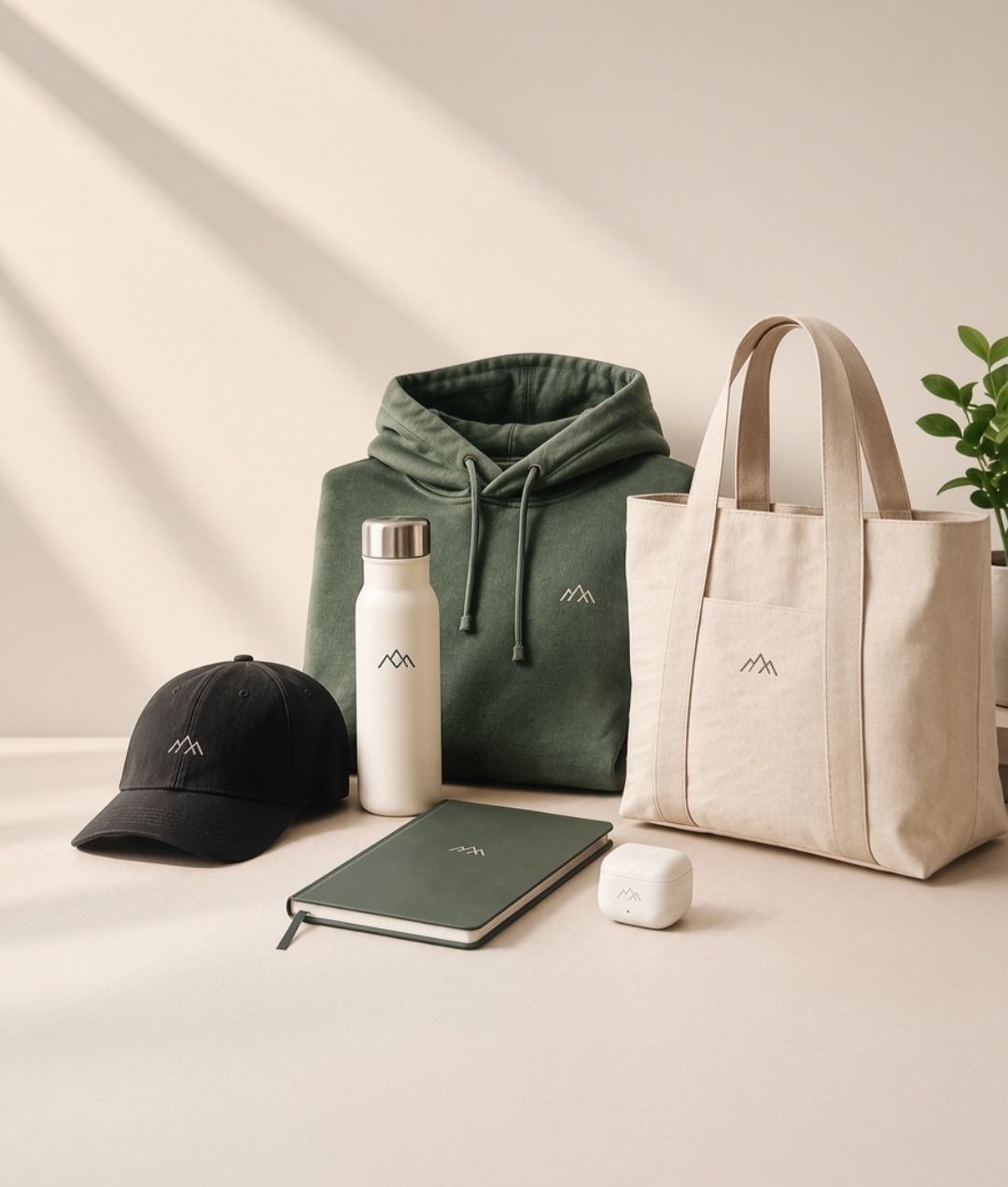
What Does “Swag That Doesn’t Look Like Swag” Mean?
It means creating branded merchandise that looks and feels like a normal retail product first and a promotional product second. The flip side is covered in our list of swag to stop buying.
The logo should complement the item rather than dominate it.
For example, imagine two company hoodies.
The first has a huge logo across the chest, three brand colors, a slogan, and a website URL.
The second is a heavyweight neutral hoodie with a small embroidered logo near the chest.
Both promote the company. But the second one has a much better chance of becoming something someone actually chooses to wear.
That same principle works across categories.
A matte stainless steel bottle can look like premium everyday drinkware. A structured tote can look like a fashion accessory. A leather-style portfolio can look appropriate in a client meeting. A minimalist notebook can sit comfortably on almost any desk.
The difference is not simply the price.
It is the combination of product choice, design, decoration, color, and branding scale.
Why Traditional Promotional Products Can Feel Outdated
Promotional merchandise has changed because people’s expectations have changed.
A product that exists only to display a logo has a harder job than one that solves an actual problem.
A cheap pen can be useful, but a thoughtfully selected notebook, wireless charging accessory, insulated bottle, or travel item can become part of someone’s routine.
Current industry research also points toward stronger demand for quality, longevity, subtle branding, and products that recipients voluntarily use rather than simply accept. Our roundup of 2026 and 2027 swag research covers the ASI and PPAI numbers behind that shift.
That does not mean traditional promotional products are useless.
It means the selection process needs more thought.
Instead of asking:
“How many items can we put our logo on?”
Ask:
“What would this person buy or use even if our logo were not on it?”
That question usually leads to better merchandise.
Start With the Product, Not the Logo
One of the easiest ways to make swag look like swag is to design around the logo first.
Try reversing the process.
Start by deciding:
Who is receiving it?
Where will they use it?
How often will they use it?
What style fits them?
What quality level makes sense?
What decoration method suits the product?
Where can the branding be placed without taking over?
Once you know the answers, choose the product.
Trendy Promo’s custom promotional products catalog covers categories including drinkware, apparel, bags, tech, office products, and more, making it easier to build merchandise around the recipient instead of starting with one generic giveaway.
A simple example
For a young technology company, a random collection of five low-cost giveaways may feel disconnected.
A cleaner combination could be:
A heavyweight neutral hoodie
A compact tech accessory
A minimalist notebook
A premium insulated bottle
The items feel like they belong together.
That is the difference between a swag collection and a merchandise system.
Use Subtle Branding Techniques
Subtle branding does not mean hiding your company.
It means giving the design enough space to breathe.
Try smaller logo placements
Instead of covering the front of a product, consider:
Left chest embroidery
Small sleeve branding
Back-neck branding
Bottom-corner placement
Handle or side placement
Tone-on-tone decoration
Small woven labels
The right placement depends on the product.
A small logo can look polished on a hoodie but may disappear completely on a busy tote. The decoration should always work with the item’s shape.
Choose the decoration method carefully
The same logo can look completely different depending on how it is applied.
For apparel, embroidery can create a more premium appearance on suitable garments.
For drinkware, laser engraving can work particularly well with certain metal finishes.
For bags, notebooks, and other products, screen printing, digital decoration, debossing, or other methods may make more sense.
Trendy Promo offers multiple decoration options depending on the product, including embroidery, laser engraving, screen printing, and digital decoration. Always confirm the available method for the specific item before ordering.
Choose Products People Already Want
A simple test:
Would someone use this on a normal Tuesday?
If the answer is yes, you are heading in the right direction.
Useful categories include:
1. Apparel
Think beyond basic promotional T-shirts.
Consider:
Quarter-zips
Hoodies
Lightweight jackets
Premium polos
Performance apparel
Structured caps
Beanies
Browse Trendy Promo’s custom apparel and wearables for options across T-shirts, polos, hats, jackets, hoodies, workwear, and more.
2. Drinkware
Drinkware works best when the product fits the recipient’s routine.
A commuter may appreciate an insulated bottle that fits a car cup holder.
An office employee may prefer a clean desk mug.
A conference attendee may want something lightweight and easy to carry.
Explore custom drinkware from Trendy Promo for bottles, tumblers, mugs, reusable cups, and related accessories.
3. Bags
Bags are useful, but they do not have to look like event giveaways.
A structured tote, recycled cotton tote, backpack, laptop bag, or compact travel bag can feel much more intentional than a thin bag with a giant logo.
For example, Trendy Promo’s Jane Recycled Cotton Buckle Tote combines an elevated shape with practical features, giving the branding room to stay understated.
4. Office and Desk Products
Office merchandise can become part of someone’s everyday workspace.
Instead of choosing five random desk items, build around one useful hero product.
Consider:
Premium notebooks
Wireless charging accessories
Desk organizers
Portfolios
Laptop sleeves
Quality writing instruments
Desk accessories
You can explore custom office and desk promotional products and narrow the selection based on the audience and use case.
Make Apparel Feel Like Real Clothing
Apparel is probably the easiest category to get wrong.
A company shirt does not automatically have to look like a company shirt.
The first thing to consider is the garment itself.
Look at:
Fabric weight
Fit
Color
Construction
Size range
Comfort
Intended use
Decoration placement
Then think about the branding.
A small embroidered logo on a quality quarter-zip can feel completely different from a huge printed logo on a basic T-shirt.
Current 2026 swag research shows growing interest in heavier fabrics, relaxed silhouettes, garment-dyed colors, and more retail-inspired apparel.
That does not mean every brand needs heavyweight streetwear.
A financial firm may want a refined quarter-zip.
An outdoor company may want performance apparel.
A creative agency may prefer relaxed casual pieces.
Retail-inspired does not mean trendy for the sake of trendy. It means choosing something people would realistically want to wear.
Choose Drinkware With Everyday Use in Mind
Drinkware is one of the most crowded promotional categories, so product selection matters.
Instead of asking for “a water bottle with our logo,” consider the actual environment.
Audience | Better Product Direction | Branding Approach |
Office employees | Mug or compact tumbler | Small logo |
Commuters | Insulated bottle | Laser engraving or subtle print |
Outdoor teams | Durable bottle | Practical, visible placement |
Conference attendees | Portable reusable bottle | Clean, simple branding |
Executive gifting | Premium drinkware | Minimal decoration |
For example, Trendy Promo’s Vasco 32oz Stainless Steel Bottle has a matte finish, stainless steel construction, a handling loop, and a design intended for everyday portability.
That type of product gives the recipient a reason to use it.
The logo becomes part of the product rather than the entire point of the product.
Upgrade Bags and Office Essentials
A bag or office accessory becomes more appealing when the design looks intentional.
Compare:
Basic approach:
Large logo + bright brand color + generic bag
Retail-inspired approach:
Neutral product + thoughtful material + small logo + useful details
A product can still communicate the brand without looking like an advertisement.
For companies with a more sophisticated identity, consider matching materials and colors across several items.
For example:
Client gift set
Structured tote
premium notebook
stainless steel bottle
New employee kit
Quarter-zip
laptop sleeve
notebook
drinkware
Conference kit
Reusable bottle
compact tech accessory
clean tote
The goal is not to add as many products as possible.
The goal is to make the combination feel intentional.
Match the Product to Your Audience
There is no universal “best swag.”
The same product can be perfect for one audience and completely wrong for another.
Ask where your recipient spends time.
For hybrid employees
Think about products that move between home and office:
Laptop sleeves
Desk accessories
Drinkware
Comfortable apparel
Travel-friendly organizers
For executives and clients
Consider products that fit professional settings:
Premium portfolios
Refined drinkware
Quality bags
Leather-style accessories
Elevated desk products
For students and younger audiences
Useful does not have to mean boring.
Consider:
Modern apparel
Compact tech accessories
Backpacks
Bottles
Crossbody or utility bags
Desk accessories
For outdoor or active teams
Prioritize durability and portability:
Performance apparel
Insulated bottles
Caps
Outdoor accessories
Travel products
The best product is usually the one that fits the recipient’s existing habits.
Use Color Strategically
Color can make promotional merchandise look either premium or overly promotional.
If your company has a strong brand color, you do not necessarily need to use it as the main product color.
Instead, try:
Neutral product + brand-color logo
Brand-color accent + neutral decoration
Tone-on-tone branding
Black or white decoration on a colored product
A limited palette across the entire collection
For example, a charcoal hoodie with a small tonal logo can communicate the brand without feeling like a walking billboard.
The same principle can work with drinkware, bags, notebooks, and tech accessories.
When Less Branding Is Actually More Effective
There is a common assumption that a larger logo automatically creates more brand visibility.
But visibility is not the only consideration.
If a person refuses to wear or use the product, the size of the logo does not matter.
A smaller logo on a product that gets used repeatedly can be more useful than a huge logo on something that gets put away.
That is why the real goal should be:
Make the product desirable enough that the recipient chooses to use it.
Then the branding travels with it.
Common Mistakes That Make Swag Look Promotional
1. Making the logo too large
Your logo does not need to occupy the entire product.
Give the design some breathing room.
2. Putting every brand element on one item
Logo, slogan, website, phone number, QR code, social handles, and multiple colors can quickly become visual clutter.
Choose the information that actually matters.
3. Choosing the cheapest version of a familiar product
A familiar category does not have to mean a cheap product.
If budget is limited, it can be smarter to buy fewer items at a better quality level.
4. Ignoring the recipient
A product that works for a trade show may not work for an executive gift.
A conference giveaway and an employee anniversary gift should not necessarily look the same.
5. Treating sustainability as a decoration
Calling something “eco-friendly” is not enough.
Look at the actual material, durability, reusability, and product lifespan. Specific information is more useful than vague sustainability language.
6. Ordering before checking the details
Before production, confirm:
Product availability
Minimum quantity
Decoration method
Decoration location
Product color
Size requirements
Packaging
Shipping
Required in-hands date
Final delivered cost
Trendy Promo’s promotional products FAQ also covers artwork, minimums, proofs, rush orders, and shipping considerations.
A Simple Formula for Better Branded Merchandise
If you are stuck between several options, use this five-part test:
1. Useful
Does it solve a real problem?
2. Good-looking
Would it still look good without the logo?
3. Appropriate
Does it fit the recipient and occasion?
4. Durable
Will it survive enough use to justify the investment?
5. Brandable
Can your branding be added without ruining the design?
If a product passes all five, it is worth considering.
If it only works because the logo is huge, go back to the product selection.
The 80/20 Rule for Swag Design
A useful way to think about branded merchandise is:
80% product appeal, 20% branding.
The exact ratio does not need to be literal.
The point is that the product should carry most of the visual appeal.
Your brand should add recognition without overpowering the item.
This is especially important for apparel, drinkware, bags, and products people carry in public.
Build a Collection, Not a Random Giveaway Box
If you are ordering multiple products, think about how they look together.
Choose a consistent:
Color palette
Logo treatment
Decoration style
Material direction
Packaging style
For example:
Modern tech brand
Charcoal quarter-zip
matte black bottle
black notebook
compact tech accessory
Outdoor brand
Performance cap
insulated bottle
durable tote
lightweight outerwear
Professional services firm
Structured portfolio
refined pen
premium notebook
understated drinkware
None of these needs a giant logo.
The collection itself communicates the brand.
Before You Order: The 10-Point Swag Check
Before approving your next promotional product order, ask:
Would I use this without the logo?
Does the product fit the recipient?
Is the quality appropriate for the occasion?
Is the logo too large?
Does the decoration suit the material?
Does the color work with the brand?
Is the product genuinely useful?
Will the recipient realistically carry or display it?
Have I checked the minimum quantity and production timeline?
Would I be happy to see someone using this product in public?
If you can confidently answer yes to most of these, you are moving in the right direction.
Final Thoughts
Swag does not have to scream for attention to be memorable.
The strongest branded merchandise often feels surprisingly normal.
A great hoodie. A bottle someone actually carries. A tote that works outside a conference. A notebook that feels good on a desk. A travel accessory that earns a permanent place in someone’s bag.
The branding is there.
It just knows when to step back.
That is the difference between merchandise people accept and merchandise people choose.
If you are building a new employee kit, client gift, conference collection, or company merchandise program, start with the people receiving it. Choose products that fit their lives, use branding with restraint, and spend your budget where the recipient will actually notice it: quality, function, and design.
Browse the Trendy Promo custom promotional products catalog to explore apparel, drinkware, bags, office products, technology, and other branded merchandise options. Good starting points are heavyweight hoodies, commuter backpacks and everyday tumblers.