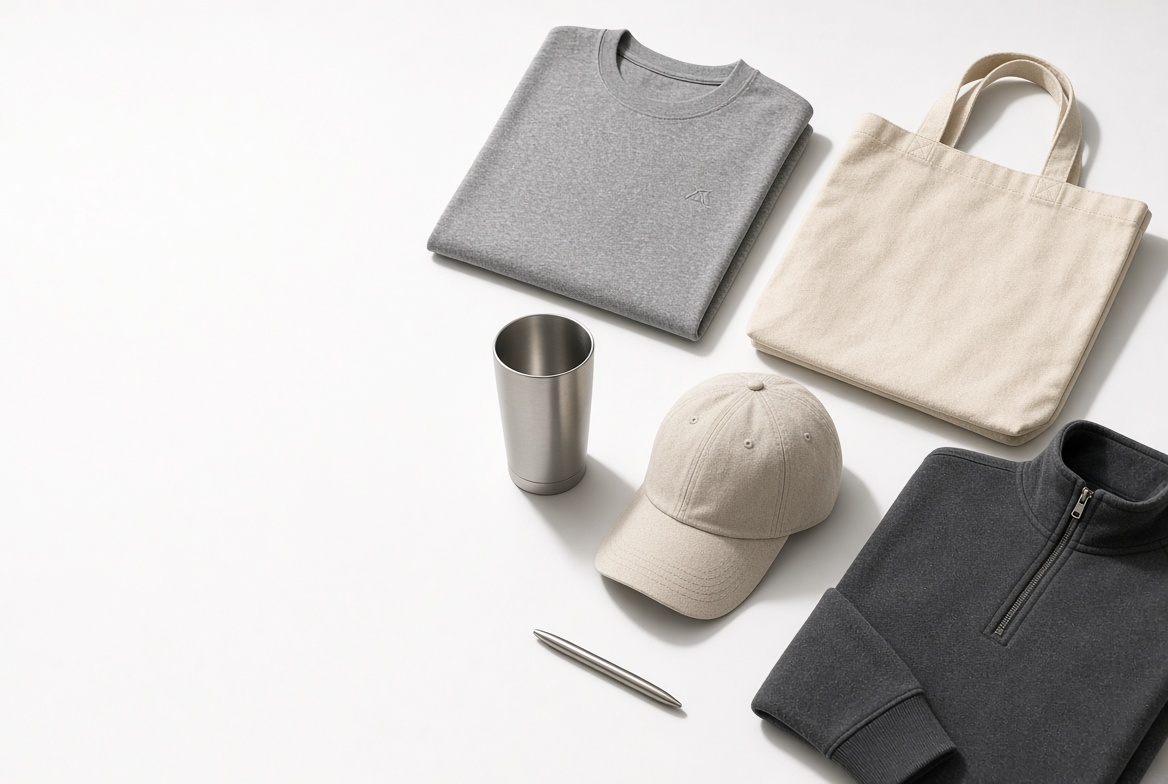
The most useful swag trend is simple: choose something people have a reason to use.
That sounds obvious until you are picking products for 300 event guests, 40 new hires, or clients spread across the country. A product can look great in a sample photo and still be awkward to carry, difficult to size, expensive to ship, or late for the event.
This guide looks at what current industry research says, then turns it into practical choices for late 2026 and 2027. Treat the ideas as a way to narrow your options, not as a list of products every company needs to buy.
What the research says
Familiar products still lead industry sales. In figures published with ASI’s 2026 Ad Impressions Study, T-shirts accounted for 16.1% of annual promotional product sales, followed by drinkware at 10.4% and polos at 9.5%. Consumers were also especially excited to receive jackets, food gifts, and blankets. (Source: ASI 2026 Ad Impressions Study)
Usefulness matters more than a product being new. ASI found that 78% of U.S. consumers would keep a promotional item because it is useful. PPAI also reported that 78.7% of surveyed distributors saw rising demand for better designed, retail style products. Those findings point toward paying closer attention to fit, materials, and everyday use. They do not mean every order needs a premium price tag. (Sources: ASI Ad Impressions Study and PPAI) For the items that tend to fail that test, see what companies should stop giving away.
1. Apparel people would choose to wear
A shirt with your logo has to work as a shirt first. Fabric weight, fit, color, and sizing will matter to the person wearing it long after the event is over.
For an employee program, consider a comfortable tee, polo, or fleece in colors people already wear. A smaller logo may suit a garment intended for work and weekends. A larger design can still make sense for a team event or fundraiser where everyone is meant to look alike.
Before ordering, confirm the full size range, collect sizes when possible, and decide how you will handle exchanges. If you are comparing decoration options, our screen printing, embroidery, DTG, and DTF guide explains where each method fits. You can then browse custom apparel with the garment and audience in mind.
Our recommendation for 2027: Put more of the budget into a garment people will wear comfortably, even if that means offering fewer styles.
2. Drinkware chosen for the workday
Drinkware remains a major promotional category, but bigger is not automatically better. A large tumbler might be welcome at a desk and inconvenient in a commuter bag. A mug might be ideal for an office kitchen and difficult to ship to individual homes.
Start with where the recipient will use it. Then compare capacity, lid design, weight, cleaning instructions, and imprint space. For gifts shipped to homes, ask how each piece will be packed.
ASI’s drinkware research found that usefulness was a key reason people kept branded drinkware, and more than three quarters of respondents said they would use a promotional drinkware item at least weekly. That supports choosing for practical use, rather than assuming any one size or style will suit everyone. (Source: ASI drinkware research)
Our promotional drinkware guide covers the product details. Use it before selecting a bottle, tumbler, or mug.
3. Bags that have a job after the event
A bag can be one of the most useful items at an event, especially when attendees need to carry other materials. Its value after the event depends on how well it fits their routine. We go deeper on that idea in branded merchandise that passes as retail.
Choose a tote when people need a simple carryall. Consider a backpack when they regularly move a laptop or other equipment. Check handles, straps, stitching, closures, and the size of anything the bag needs to hold.
ASI estimates that a $6 tote can generate nearly 5,000 impressions over its lifetime. That is a research estimate, not a promise for every tote. A bag that is comfortable and sturdy enough to keep using gives your program a better chance of lasting beyond the event. (Source: ASI Ad Impressions Study)
For help choosing between styles, read our tote bag versus backpack guide.
4. Branding that fits the item
A logo does not need to cover every available inch to be noticed. On apparel, bags, and desk products, the right placement depends on how the item will be used. Small items follow the same rule, which is why the case for smaller, well-made branded items matters for 2026 budgets.
A small mark might make sense on a client gift or everyday jacket. A bold design might be right for a festival shirt or campaign giveaway. Neither choice is a universal rule. Look at the product, the audience, and whether the item will still make sense after the occasion has passed.
Keep approved logo files in one place before requesting proofs. If different departments order throughout the year, a company store may help them use the same approved products and artwork.
5. Material claims you can explain
Buyers may care about recycled materials, domestic sourcing, or products designed for long use. The details behind those claims matter.
Before describing an item as recycled or Made in USA, check the supplier’s documentation for the specific product. Find out which component the claim covers and whether decoration or assembly takes place somewhere else. Do not turn a claim about one part of a product into a claim about the whole item.
ASI reported increased favorable views of advertisers associated with sustainable, Made-in-USA, or socially responsible promotional products compared with its previous study. That is a reason to examine these options carefully, not a reason to add an unsupported claim to a product page. (Source: ASI Ad Impressions Study)
Our eco-friendly promotional products guide explains what to verify before ordering.
6. Gifts matched to the moment
A new hire, a conference visitor, and an employee celebrating five years with the company do not need the same gift.
Start with the occasion. A new hire may appreciate a notebook, a pen, and something useful during the first week. A client gift may call for one carefully chosen item. An event giveaway needs to be easy to hand out and carry.
PPAI’s research points to growing demand for better designed products. Our buying recommendation is to use that as a reason to choose fewer, more fitting items when the budget allows. It is not evidence that every organization needs a larger gift box. (Source: PPAI)
For onboarding, use our employee welcome kit checklist to decide what belongs in the box.
7. Tech that works with the recipient’s devices
A useful tech gift solves a small, real problem. Before choosing a cable kit, charging pad, or power bank, check the devices your recipients use and what the product supports.
Battery products need extra attention to documentation and shipping. If your deadline is close, confirm the exact product’s production and delivery options before making it the centerpiece of a kit. Our custom power banks guide covers the questions to ask.
Our recommendation for 2027: Choose a simpler accessory when you cannot confirm compatibility or meet the required delivery date.
What to buy for your program
Program | A useful starting point | Check before ordering |
|---|---|---|
Trade show | Easy to carry giveaways, with a separate gift for planned meetings | Quantity, booth space, handout plan, and delivery to the venue |
New hire onboarding | A few items useful during the first week | Sizes, home shipping, packaging, and arrival date |
Client appreciation | One item or a small gift set matched to the relationship | Recipient details, presentation, and shipping conditions |
Employee recognition | A gift suited to the milestone and recipient | Personalization, approvals, and delivery to each location |
These are starting points for custom promotional swag, not fixed kits. A field team and an office team may need very different products even when the occasion is the same.
What we would leave out of the order
Some products are right for a specific job but poor choices when added just to fill space:
Apparel ordered without a workable size plan
Drinkware selected only because it is larger
Tech that has not been checked against the recipient’s devices
Food gifts shipped without checking allergens, shelf life, or heat exposure
Extra items that make a kit harder to pack without making it more useful
If you are planning a booth, our trade show giveaway guide goes deeper into which items belong with quick handouts and which should be reserved for conversations.
Plan the delivery before picking the product
Write down the date the items must arrive. Then work backward through artwork, proof approval, production, packing, and shipping.
Timing varies by product, decoration, quantity, and destination. A rush option on one item does not mean the entire order, including freight, can arrive the next day. Share your date early so the available products can be checked against it.
Budget for the delivered order, including decoration, setup when applicable, packaging, freight, and individual shipments. A lower unit price can lose its advantage if the item is expensive to pack or ship.
What to send us for a recommendation
Send Trendy Promo the occasion, quantity, audience, delivery date, destination or shipping pattern, budget, and your current logo file. Mention any size, material, food, or battery requirements.
Contact Trendy Promo, and we can help narrow the options to products that fit the people receiving them and the time available. If apparel leads your list, start with heavier hoodies and sweatshirts.