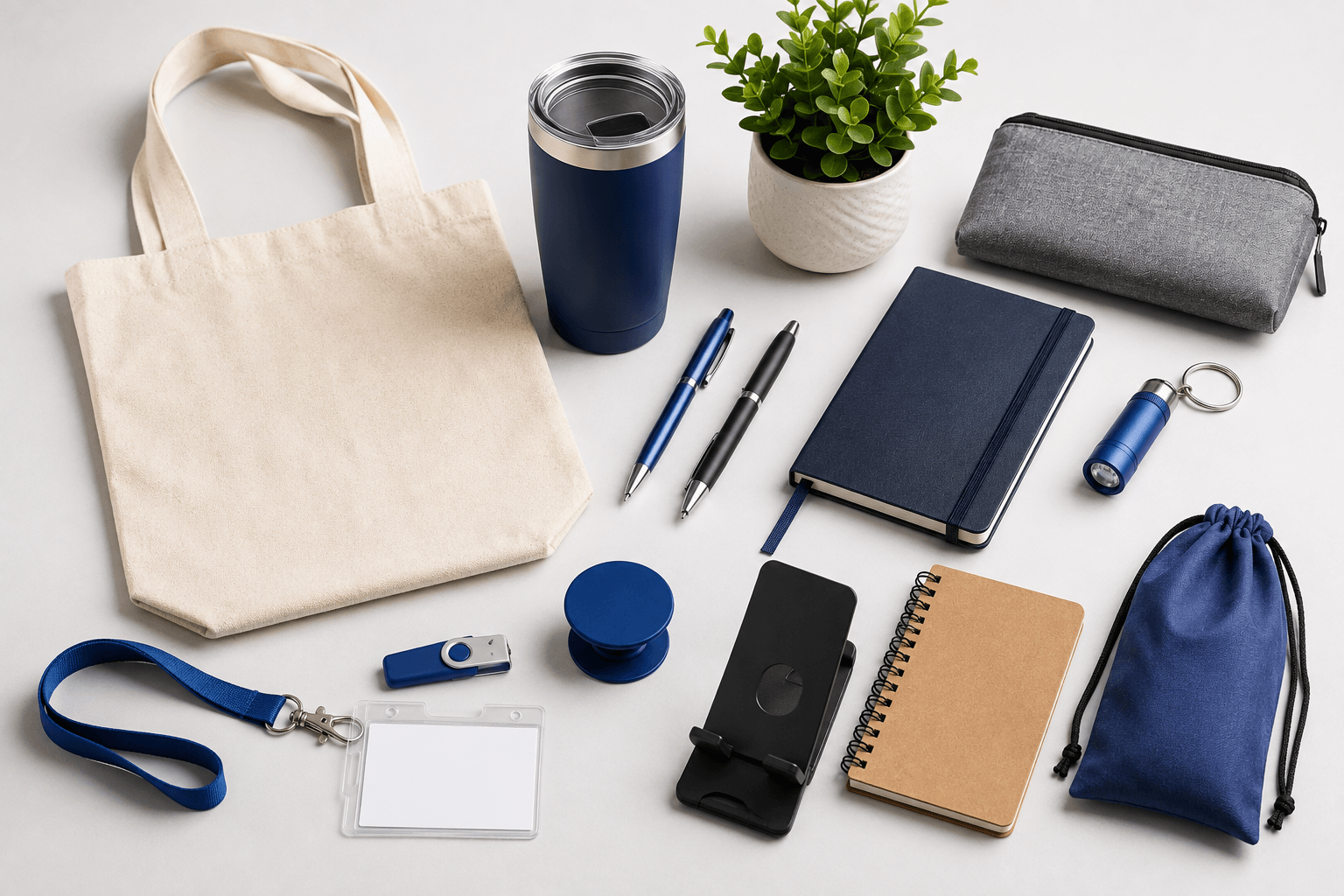
Promotional products have a strange reputation when it comes to price. People often assume that a small budget means settling for something nobody really wants.
That isn't necessarily true.
There are plenty of inexpensive promotional products that make sense when they're chosen for the right audience. A simple pen can be perfect for a large conference. A reusable bottle may make more sense for an employee event. A small tech accessory might work better for a younger audience than another traditional giveaway.
The price matters, of course, but it isn't the whole story.
What matters more is whether somebody has a reason to keep the product after you hand it to them.
If you're working with a specific budget, breaking your options into products under $1, $3, $5 and $10 is a practical way to start. It helps you narrow down an enormous catalog without choosing a product simply because it happens to be cheap.
One quick note before getting into the ideas: promotional product pricing can change depending on quantity, decoration, product color, imprint location and supplier requirements. Setup, shipping and other charges may also apply. Think of these price points as shopping ranges rather than guaranteed final decorated prices.
Quick Answer: What Each Budget Buys
Budget per piece | Items that usually fit | Best for |
|---|---|---|
Under $1 | Pens, key tags, silicone wristbands | Big events, counters, mailers |
Under $3 | Lanyards, small notebooks, phone accessories, basic totes | Conferences, schools, welcome bags |
Under $5 | Drawstring bags, better notebooks, outdoor items, desk accessories | Trade shows, community events |
Under $10 | Drinkware, better bags, simple tech, small coolers | Customers, staff, qualified leads |
These are typical catalog ranges at volume before setup and freight. Your quote decides the final number.
Promotional Products Under $1
When you're buying for a few thousand people, every dollar matters.
That is where promotional products under $1 can be surprisingly useful.
This price range is usually best for events where you want broad exposure rather than a premium gift experience. Think community events, school programs, trade shows, open houses, recruitment events and large public promotions.
You can browse Trendy Promo's promotional products under $1 here: Shop promotional products under $1
Pens are still hard to beat
Promotional pens are not particularly exciting, but that's almost beside the point. If pens make your list, our pen buying guide explains which refills hold up, and you can compare budget-friendly logo pens once you know the quantity.
People use pens.
They disappear into purses, cars, desk drawers, reception areas and conference rooms. A decent promotional pen can stay in circulation long after an event is over.
The important word there is decent.
If the pen barely writes or feels like it's going to fall apart, saving a few cents doesn't accomplish much. When budgets allow, I would rather move slightly above the absolute cheapest option and choose something people won't immediately throw away.
Pens make particularly good sense for banks, healthcare offices, real estate businesses, universities, insurance companies and conferences.
Key tags can stick around
Key tags and small key accessories don't give you a huge imprint area, but they can have staying power.
If someone attaches one to a set of keys, your logo may remain with that person for months.
They can work well for property managers, auto businesses, apartment communities, service companies, schools and membership organizations.
This is a good example of why the size of the promotional product doesn't always determine its value.
Wristbands work when they belong at the event
Wristbands are useful for a different reason.
They already have a purpose.
At a festival, sporting event, fundraiser or school function, a wristband can identify attendees while also carrying the event or sponsor branding.
That feels much more natural than handing somebody an unrelated promotional item simply because there was room in the budget.
What I would look for under $1
At this price, I wouldn't worry about finding the most impressive item in the catalog. For a squeezable option, our stress ball buying guide covers shapes, minimums and imprint size.
I'd look for something uncomplicated, useful and easy to hand out.
If you're distributing 5,000 pieces, a product doesn't have to feel like a gift. It just needs to make sense.
Promotional Products Under $3
A few extra dollars opens up a noticeably different group of products.
Browse current promotional products under $3 here: Shop promotional products under $3
This is a particularly useful budget for trade shows because you can often find products that still work at scale without feeling quite as disposable.
Lanyards make sense when people actually need one
Lanyards are a perfect example.
If everybody at a conference already needs to wear a badge, putting your branding on the lanyard is an easy decision.
The same applies to schools, corporate campuses, volunteer organizations and training programs where people use badges, keys or identification cards.
Before you order, check lanyard sizes and attachments so the strap fits both your badge and your logo.
Promotional products tend to work best when they fit naturally into whatever the recipient is already doing.
Small notebooks are underrated
A compact notebook isn't going to stop somebody in their tracks at an expo booth.
But give it to someone who is about to sit through six conference sessions and suddenly it becomes useful.
That is the kind of usefulness I would pay attention to.
You also don't need to cover the entire notebook with an enormous logo. A smaller, cleaner imprint often gives an inexpensive notebook a much better appearance.
Simple phone accessories can work well
Almost everyone carries a phone, which makes certain low-cost phone and screen accessories worth considering.
The trick is avoiding novelty for the sake of novelty.
Something that solves one small everyday problem usually has a better chance of being kept than a gadget with a long list of features that nobody asked for.
Totes can do more than advertise your logo
At a trade show, people collect everything.
Brochures. Samples. Business cards. Catalogs. Giveaways.
A lightweight tote gives them somewhere to put all of it.
That makes the bag useful immediately, and the larger decoration area gives your brand more visibility than most small promotional items.
If you're already supplying bags at an event, you may even be able to reduce the number of smaller giveaways you need.
Promotional Products Under $5
The under-$5 range is where things start getting more interesting.
Browse promotional products under $5 here: Shop promotional products under $5
At this level, you can often move from products that feel like giveaways toward products that feel more like merchandise.
That distinction matters.
Someone may grab a giveaway because it's free. They keep merchandise because they actually like it.
Drawstring bags are practical for the right crowd
Drawstring bags work especially well for schools, youth programs, gyms, races, company wellness events and recreational programs.
They're light, easy to distribute and offer plenty of room for a logo.
More importantly, they're something people may continue using after the event.
A promotional product becomes much more valuable once it leaves the event with the recipient.
A better notebook can make a difference
At this price point, it's worth looking at the little details.
A stronger cover. An elastic closure. Better binding. A pen loop. Recycled materials.
None of those features sounds dramatic by itself, but together they can make a notebook feel noticeably better.
A useful notebook that stays on somebody's desk is doing exactly what a promotional product should do.
Outdoor giveaways should fit the weather
If you're hosting an outdoor summer event, don't automatically reach for the same products you would use at an indoor conference.
A cooling towel or another outdoor-oriented product may be much more appreciated.
The environment should influence what you buy.
This sounds obvious, but it's one of the easiest things to forget when you have thousands of products to choose from.
Desk accessories can have a surprisingly long life
Some of the best promotional products aren't exciting at all.
They're simply convenient.
If a small desk accessory sits beside someone's laptop every day for the next year, your logo is getting far more exposure than it would from something flashy that was used once and forgotten.
For office and hybrid-work audiences, that matters.
Promotional Products Under $10
Under $10 is one of my favorite promotional product ranges because it gives you enough room to find something that feels substantial without turning every giveaway into a major expense.
Browse promotional products under $10 here: Shop promotional products under $10
This budget can work particularly well for employees, customer events, recruiting programs, conferences and smaller appreciation campaigns.
Drinkware gives your logo plenty of opportunities to be seen
Drinkware has stayed popular for a simple reason: people regularly use it.
A bottle can go to the gym.
A tumbler may sit beside someone's computer all day.
A mug can end up in an office kitchen for years.
That repeated use is what makes drinkware attractive from a branding perspective.
But don't choose drinkware based only on appearance.
Think about capacity, lids, materials, how it will be decorated and where the recipient is likely to use it.
We put together a separate guide covering those decisions in more detail: How to Choose the Right Promotional Drinkware for Your Brand
Better bags can outlive the event
One of the easiest ways to judge a promotional bag is to forget about the logo for a moment.
Look at the bag itself.
Would you take it to work?
Would you use it at the grocery store?
Would you carry it to the gym?
If you wouldn't use it without the logo, there's a reasonable chance your recipient won't either.
A promotional product should still be a good product.
Tech accessories work when they're genuinely useful
Tech products get attention because they feel modern, but that doesn't automatically make them a good promotional choice.
I would rather give somebody one simple accessory they understand immediately than a strange gadget they need instructions to use.
Think about your audience's everyday routine.
What are they plugging in, carrying, charging or organizing?
That is usually where the better ideas are.
Small coolers can feel more expensive than they are
Lunch bags and small coolers are useful because they have a fairly obvious purpose.
Employees can bring lunch to work. Families can take them outside. Construction and field teams can carry food or drinks.
They can also give you a good amount of decoration space without making the branding feel overwhelming.
For the right audience, that is a strong combination.
Don't Choose the Budget Before You Know the Audience
It can be tempting to say, "We need something under $3," and start shopping immediately.
I would go one step earlier.
Who is receiving it?
If you're ordering for 4,000 attendees at a community event, $3 per person is already a $12,000 merchandise budget before you account for other costs.
If you're buying for 100 employees, you may have room to spend more on each person and choose something substantially better.
If you're thanking 25 important customers, I'd probably approach the decision differently again.
Customer gifts aren't really about maximum distribution. They're about the relationship.
For more ideas in that area, see our guide to 10 Best Corporate Gifts for Client Appreciation.
There isn't one correct promotional-product budget.
There is only a budget that makes sense for the campaign you're running.
Pay Attention to the Final Cost, Not Just the Product Price
This is where promotional-product shopping sometimes gets confusing.
You may see a product listed at $2.75 and reasonably assume that ordering 500 means you'll spend $1,375.
Maybe.
But the final order can also depend on the decoration method, setup requirements, additional colors or imprint locations, packaging and freight.
Rush production can change the economics too.
That doesn't mean promotional pricing is complicated for the sake of being complicated. Different products are decorated in very different ways.
It simply means the starting unit price shouldn't be the only number you use when comparing options.
Ask for the complete estimated cost.
If you're unfamiliar with how artwork, virtual proofs, minimum quantities, setup charges and production work, our Promotional Products FAQ covers many of the common questions.
Affordable Doesn't Have to Mean Forgettable
I would rather give somebody a good $2 item than a bad $8 item.
Price alone doesn't determine whether a promotional product works.
Ask yourself a few questions before approving an order.
Would I use this myself?
Does it make sense for the people receiving it?
Is the product appropriate for where we're giving it away?
Does my logo look natural on it?
Will it be easy for people to carry home?
Would I be comfortable putting my company's name on this particular product?
Those questions tend to reveal more than another hour spent comparing a few cents between similar products.
Should You Reach More People or Give Fewer People Something Better?
Suppose your merchandise budget is $5,000.
You could potentially spread that money across thousands of inexpensive products.
Or you could give a much smaller group something considerably better.
Both approaches can work.
At a public event, reaching as many relevant people as possible could be exactly what you want.
For employee recognition, I'd probably care more about how the product feels when somebody receives it.
For important customers, I'd usually favor quality over quantity.
The budget doesn't make that decision.
The purpose of the campaign does.
Match the Product to the Moment
This is probably the simplest advice in this entire guide. Small items can still carry a big moment, as our look at micro-merch shows.
Give people something that makes sense at the moment they receive it.
At a trade show, make it easy to carry.
At an outdoor summer event, give them something useful outside.
For employee onboarding, think about items they'll actually use during the workweek.
For schools, consider practical products students can carry or use.
For customer appreciation, spend more time thinking about presentation and perceived quality.
If the product feels like it belongs in the situation, it won't come across as random advertising.
Your Logo Doesn't Need to Cover the Whole Product
There's a tendency with promotional merchandise to think bigger branding automatically creates more exposure.
Sometimes it does the opposite.
A huge logo can make an otherwise attractive item look like advertising instead of something somebody chose to own.
This is especially noticeable on drinkware, notebooks and bags.
Your branding should be easy to recognize, but it should still work with the product.
A clean imprint in the right location often looks far better than filling every available inch.
If people like how the item looks, they're more likely to keep using it.
That's the exposure you really want.
How Quantity and Setup Change the Price per Piece
Setup is a flat charge, so it weighs most on small orders. Example math with a $50 setup: on 100 pens it adds $0.50 to each pen, on 500 pens it adds $0.10. A pen listed at $0.70 lands at $1.20 per piece on a 100-piece run once that setup is added, before freight, which moves it out of the under $1 tier. Typical setup is $25 to $75 per color or location (see setup fees explained), so a one-color logo keeps budget items on budget.
Planning Earlier Can Save More Than Choosing a Cheaper Product
Businesses will sometimes spend days trying to shave 20 cents from a unit price and then pay for expedited production because the event is next week.
Planning earlier gives you more options.
You can compare products properly.
You have more flexibility with decoration.
Artwork can be reviewed without rushing.
Standard shipping becomes more realistic.
And if a product suddenly goes out of stock, you still have time to find a replacement.
The cheapest unit price isn't always where the biggest savings are.
So, What's the Best Promotional Product for the Money?
There isn't one.
That's actually the point.
The best product under $1 for a large festival may be completely wrong for an employee welcome package.
The best product under $10 for a conference may not make sense for a school fundraiser.
The strongest promotional campaigns usually get a handful of things right at the same time: the audience, the budget, the timing, the product and the branding.
So instead of asking:
"What is the cheapest thing we can put our logo on?"
Try asking:
"What can we give these people, within our budget, that they'll actually want to keep?"
That's a much better place to start.
Find Promotional Products That Fit Your Budget
If you already know what you want to spend, you can start with the appropriate price range:
Promotional products under $1: Browse under $1
Promotional products under $3: Browse under $3
Promotional products under $5: Browse under $5
Promotional products under $10: Browse under $10
Then narrow the choices by quantity, audience, deadline and how you expect people to use the product.
Sometimes the best answer really is the 80-cent giveaway.
Sometimes spending another $3 changes everything.
The important part is knowing why you're choosing it.