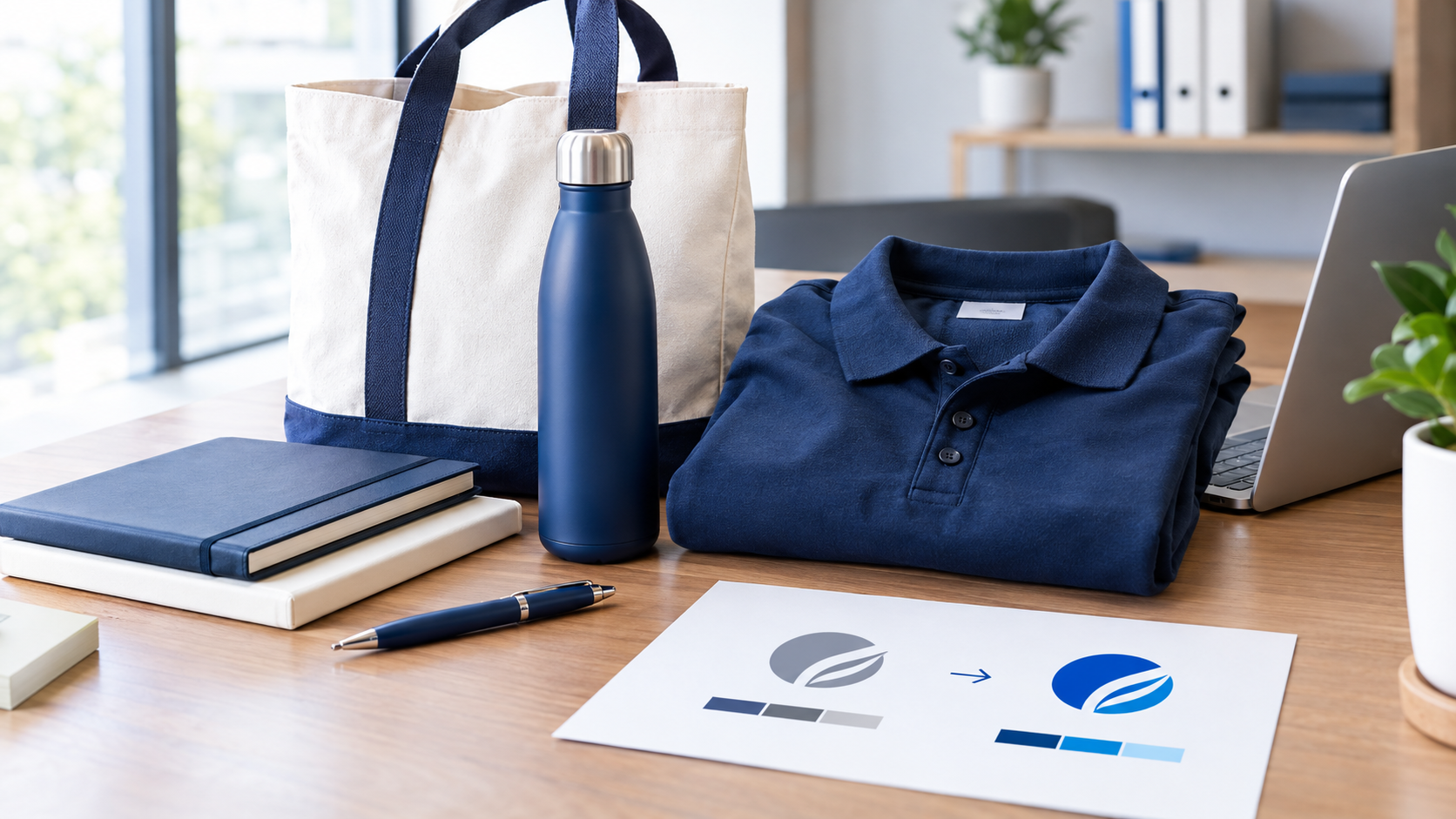
A company rebrand involves more than changing a logo. Businesses also need to review the promotional merchandise they already own, from branded notebooks and tote bags to employee apparel, drinkware, and trade show giveaways.
When a company updates its name, logo, colors, or tagline, existing merchandise can suddenly feel outdated. Ordering an entirely new collection might seem like the easiest solution, but it can also create unnecessary costs, excess inventory, and avoidable waste.
The smarter approach is to assess what you already have, determine what can still be used, and plan the transition around your business needs.
Whether you are refreshing your corporate identity, preparing for a product launch, or updating your employee merchandise program, a clear plan can help you maintain brand consistency without replacing every item overnight.
Why Promotional Merchandise Needs a Rebranding Plan
Promotional products often remain in circulation long after a company changes its branding. Marketing teams may have boxes of old event giveaways, HR may have employee welcome kits in storage, and sales teams may still be using branded gifts purchased months earlier.
Without a coordinated plan, different departments can end up distributing merchandise with different logos and visual identities.
Common challenges include:
Outdated branding: Products display a retired logo, tagline, company name, or website.
Unnecessary replacement costs: Teams order new merchandise before checking existing stock.
Inconsistent brand presentation: Different departments continue using different versions of the brand.
Unused inventory: Products remain in storage because nobody knows whether they can still be distributed.
Last-minute orders: Teams rush to replace merchandise before a launch, conference, or customer event.
A well-planned transition helps businesses make informed purchasing decisions and maintain a consistent identity across their merchandise.
If your company is preparing for a campaign or event during the transition, it is worth reviewing how to measure promotional product ROI before deciding which items to replace. The right merchandise should support a clear business objective, not simply display the newest logo.
1. Audit Your Existing Promotional Merchandise
Before placing a replacement order, create a complete inventory of your existing branded products.
Start by checking the stock held by marketing, HR, sales, procurement, event teams, and individual offices.
For each product, record:
Product name and description
Quantity available
Existing logo or design version
Condition and usability
Storage location
Intended audience
Original purchase cost, if available
Estimated replacement cost
Upcoming plans for distribution
This information helps you understand the scale of the transition before committing additional budget.
For example, a business might discover that it has 250 notebooks with the previous logo, 100 reusable bottles, and several boxes of unused event giveaways. Rather than automatically replacing everything, the team can evaluate each product based on its condition, intended use, and compatibility with the new brand.
This is also a good time to identify products that are no longer relevant to your audience.
For companies managing several merchandise programs, Trendy Promo’s guide to branded merchandise for SaaS companies offers a useful example of organizing merchandise around employee needs, company stores, and specific use cases rather than distributing the same items to everyone.
2. Decide Which Products Can Still Be Used
Not every product carrying an old logo automatically needs to be discarded. The appropriate decision depends on the extent of the rebrand, the intended audience, and the company’s brand guidelines.
Divide your existing inventory into three categories.
Products suitable for continued use
Some products may remain acceptable if their branding is still approved or if they do not carry outdated brand elements.
Examples include:
Unbranded office supplies
Products featuring an approved transitional logo
Merchandise whose design remains consistent with the updated identity
Confirm approval with the brand team before continuing distribution.
Products requiring a limited-use decision
Some merchandise may be suitable for a specific internal purpose but inappropriate for customer-facing events.
For example, older notebooks might be considered for an approved internal use while the company completes its transition. However, the decision should follow the company’s brand guidelines rather than assuming that internal distribution is always acceptable.
Products requiring replacement or withdrawal
Products displaying an obsolete company name, incorrect contact details, a retired tagline, or branding that could mislead customers may need to be removed from circulation.
Depending on the product and company policy, possible options include authorized redecoration, donation, recycling, or appropriate disposal.
The important point is to make the decision deliberately instead of allowing outdated inventory to remain in storage indefinitely.
3. Determine Whether Existing Products Can Be Rebranded
In some cases, an existing product can be updated without replacing the entire item.
Possible solutions include replacing outdated packaging, using a suitable removable component, or applying a new imprint when the product and decoration method allow it.
However, redecoration is not practical for every product. An existing logo may remain visible beneath a new imprint, and certain surfaces may not support a clean replacement.
Before approving the work, ask your supplier to evaluate:
Whether the old branding can be covered properly
Whether the new logo will reproduce clearly
Whether the product material supports the proposed decoration method
Whether redecoration will affect the product’s appearance or durability
Whether the total cost compares favorably with a replacement order
For example, updating a suitable notebook cover may be straightforward, while changing a logo printed directly onto a curved or textured product could be more complicated.
Review Trendy Promo’s artwork requirements for promotional products before approving a new imprint. The artwork format, color requirements, and usable imprint area all affect the finished result.
Request a sample or appropriate visual proof when necessary, particularly if the merchandise will be used in a public-facing campaign.
4. Establish a Clear Brand Transition Date
A company should establish when its new branding becomes the approved standard for merchandise production and distribution.
Without a clear transition date, different teams may continue placing orders with outdated artwork, creating additional inventory that needs to be replaced later.
Your transition plan should identify:
The date the new branding becomes effective
The last date for placing orders using the old artwork
Which existing products may continue to be distributed
Which products must be withdrawn
Who approves exceptions
How outstanding purchase orders will be handled
When suppliers must stop using retired artwork
Communicate the plan to everyone involved in ordering or distributing branded products.
Suppliers should receive the updated artwork and written instructions before any repeat order is placed. This is particularly important when different vendors handle apparel, office supplies, drinkware, and event merchandise.
5. Create a Centralized Artwork Library
A rebrand is an excellent opportunity to organize the files used for promotional product production.
Businesses should maintain a central location for approved logos, color specifications, and product-specific artwork instructions.
Your library may include:
Current primary logo files
Approved one-color and reversed logo versions
Brand color specifications
Simplified logos for small imprint areas
Current tagline and legal wording, where applicable
Decoration instructions for different product types
Retired files clearly marked as obsolete
Assign responsibility for approving artwork and updating the library.
This helps prevent suppliers from accidentally using old logos or making unauthorized changes to the design.
Before submitting your next merchandise order, consult Trendy Promo’s artwork requirements guide to understand the file formats, imprint considerations, and approval checks that can affect production.
The goal is to ensure that every new order starts with the correct artwork instead of discovering errors after production begins.
6. Prioritize Merchandise Replacement by Business Need
Replacing every product simultaneously can put unnecessary pressure on the budget.
Instead, prioritize orders according to upcoming deadlines, visibility, and business importance.
Priority | Merchandise | Recommended action |
High | Products needed for an upcoming public launch | Confirm new branding and delivery requirements first |
High | Items displaying incorrect company information | Review for immediate withdrawal or replacement |
Medium | Employee onboarding merchandise | Coordinate with hiring plans and internal communications |
Medium | Client gifts and sales merchandise | Align replacement with customer-facing activities |
Lower | Unused inventory without an immediate distribution plan | Audit before deciding whether replacement is necessary |
This approach helps teams direct their budget toward the products that matter most.
For example, merchandise needed for a major product launch may require immediate attention, while regular office supplies can transition according to existing stock levels and company policy.
If the new merchandise is intended for an event, start with the audience and the intended outcome. Trendy Promo’s guide to trade show giveaways that increase leads explains why giveaway selection should be connected to booth activity and lead quality rather than simply the number of items distributed.
7. Plan Replacement Orders Around Actual Demand
Once the business has identified the products that need replacing, estimate realistic quantities before requesting quotes.
Avoid automatically repeating previous order quantities. A rebrand may coincide with changes in employee numbers, event schedules, customer campaigns, or product preferences.
Consider the following:
Upcoming events and confirmed attendance
Employee onboarding forecasts
Planned customer campaigns
Existing stock levels
Expected usage over the next few months
Minimum order quantities
Product availability
Budget per item and total delivered cost
Shipping destinations and delivery deadlines
For example, a company preparing for a major launch may need a larger quantity of new merchandise immediately. Its regular office supplies, however, may be replaced gradually as demand requires.
Compare bulk orders with smaller quantities based on total cost and expected usage. A lower unit price is not necessarily a better deal if much of the order will remain unused.
For a practical ordering workflow, read How to Order Promotional Products. It covers the key considerations involved in product selection, artwork, proof approval, production, freight, and delivery planning.
8. Keep the New Merchandise Visually Consistent
A successful rebrand requires more than replacing an old logo with a new one. The entire merchandise collection should reflect the updated visual identity.
Before approving products, review the following elements.
Logo placement: Maintain consistent placement across similar product types wherever practical.
Color accuracy: Confirm that the selected product and decoration method can reproduce the approved brand colors appropriately.
Readability: Make sure the logo remains clear on smaller products such as pens, compact accessories, and bottle imprints.
Product suitability: Select materials and decoration methods appropriate for the intended use.
Design flexibility: Maintain approved versions for different backgrounds and imprint sizes.
Consistency does not mean every product must look identical. It means the collection should feel like part of the same brand.
If you are refreshing branded apparel as part of the transition, check the decoration requirements before selecting the garment. The artwork that works well on a large shirt design may need to be simplified for a smaller imprint area.
A little planning during product selection can prevent inconsistent results across suppliers and merchandise categories.
9. Understand the Full Cost of the Transition
The cost of a merchandise rebrand extends beyond purchasing new products.
Your budget may need to include:
Replacement merchandise
Decoration and setup charges
Artwork preparation
Redecoration of suitable existing products
New packaging
Shipping and handling
Storage or disposal costs
Rush production charges, if required
Compare the total cost of redecoration against the cost of replacement before making a decision.
For example, imagine a company has 200 existing notebooks. A supplier quotes $4 per notebook for suitable redecoration, while a replacement notebook costs $5 per unit before shipping and setup.
Option | Illustrative product cost |
Redecorate 200 notebooks at $4 each | $800 |
Replace 200 notebooks at $5 each | $1,000 |
In this simplified example, redecoration has a $200 lower product cost. However, the company must also consider the notebooks’ condition, the quality of the new imprint, additional handling costs, and whether the finished product will meet its brand standards.
These figures are illustrative only, not actual Trendy Promo prices or supplier quotes.
For a broader approach to evaluating the effectiveness of your merchandise spending, see Promotional Products ROI: How to Measure What Actually Works. Measuring the full cost and intended outcome helps businesses make better decisions about future merchandise programs.
10. Plan Ahead for Time-Sensitive Merchandise
A rebrand can create several simultaneous deadlines: a new website launch, a conference, an employee announcement, or an upcoming customer campaign.
Waiting until the last minute to order replacement merchandise can limit product choices and increase costs.
Start by confirming the required in-hands date, quantity, available product options, artwork readiness, proof approval, production schedule, and shipping method.
If a deadline is approaching, review 24-Hour Rush Promotional Products: What Is Actually Possible in a Day. Rush availability depends on the specific product, decoration method, quantity, inventory, approval timing, and shipping requirements.
A product that can be decorated quickly is not necessarily a product that can be delivered the next day. Confirm the complete timeline before committing to an event or launch date.
Where possible, keep the deadline fixed but remain flexible about product selection. An alternative product with the correct branding and confirmed availability may be more practical than insisting on an item that cannot arrive in time.
11. Build a Repeatable Process for Future Brand Changes
A rebrand should not leave the company with the same inventory and artwork problems the next time its identity changes.
Create a repeatable process connecting brand management, purchasing, inventory control, and supplier communication.
A practical system includes:
One approved artwork library: All departments and suppliers use current files.
A designated brand owner: One person or team approves artwork and exceptions.
An inventory register: Product quantities, design versions, and storage locations are recorded.
A supplier notification process: Vendors receive updated artwork before repeat orders.
A replacement policy: Teams know how to handle outdated merchandise.
A regular inventory review: Existing products are checked before new purchases.
A budget review: Replacement costs are considered alongside other rebranding expenses.
For companies that order merchandise regularly, these steps can also improve consistency across recurring employee, customer, and event programs.
The result is a more organized purchasing process and fewer surprises when the company’s visual identity changes.
Make Your Next Merchandise Order Count
A company rebrand does not have to mean replacing every branded item overnight. With a clear inventory audit, approved artwork, realistic replacement priorities, and careful purchasing decisions, businesses can transition to their new identity while making better use of their existing resources.
The key is to plan before ordering. Understand what you already have, decide what needs to change, and choose products that support the updated brand over the long term.
Whether you are preparing for a company launch, refreshing employee merchandise, or replacing products for an upcoming event, the right promotional products partner can help you evaluate suitable products, decoration options, and delivery requirements.
Planning a branded merchandise refresh? Visit Trendy Promo to explore promotional products for your company’s next campaign, event, or brand update.