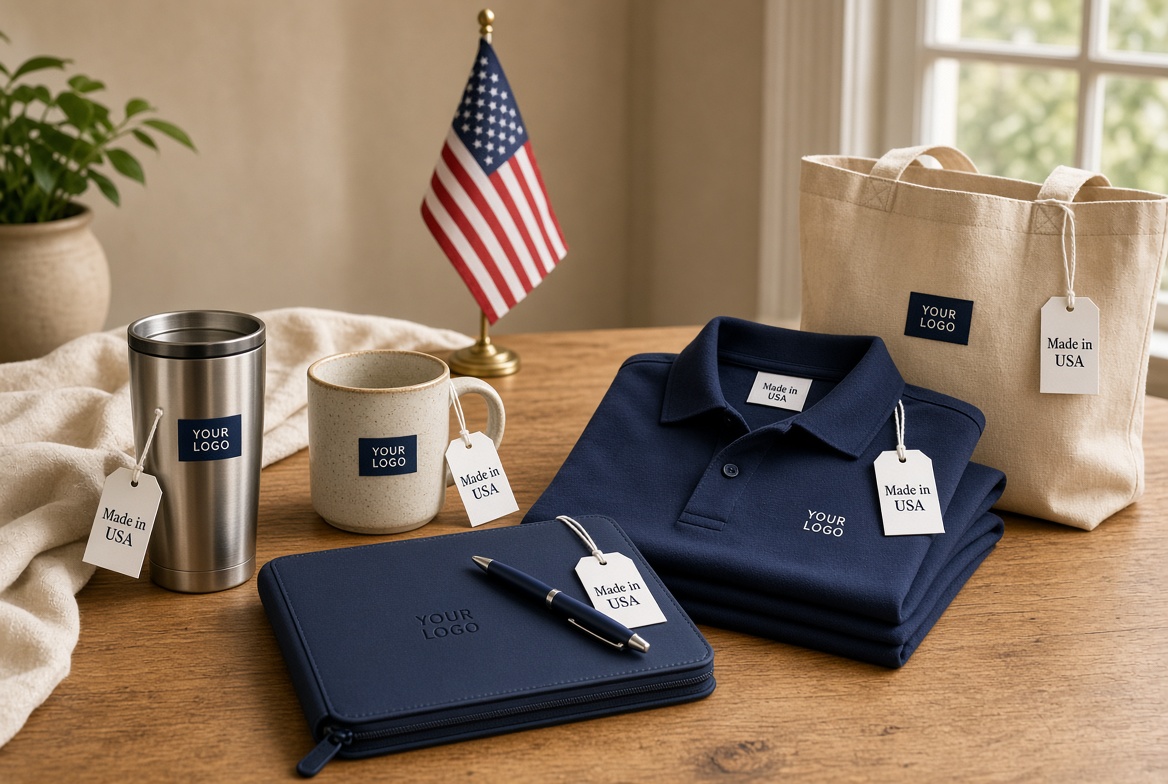
Procurement asks for Made in USA.
A catalog search gives you a list of products.
That is only the beginning.
The real job is deciding which products can support the exact origin claim your organization needs, which ones fit the budget, which ones can meet the date, and which ones people will actually use.
This is not another patriotic product roundup.
It is an FTC-aligned, compliance-aware buying framework for businesses that need to understand what the origin language means before putting it on a quote, proposal, campaign, or product.
It is buying guidance, not legal advice.
Trendy Promo is a U.S. promotional products distributor, not a factory. Products are produced and decorated through supplier facilities in the United States and internationally.
If product origin matters to the order, put that requirement in the first request.
Do not wait until the proof.
Start with the Made in USA product search, then verify the exact product before approving the order.
If budget is already defined, use the Budget Calculator before narrowing the shortlist.
Quick answer: what claim do you actually need?
What the buyer needs | What to request | What not to assume |
|---|---|---|
An unqualified Made in USA claim | A product the supplier can substantiate under the applicable U.S.-origin standard | A search badge is proof |
U.S. decoration on a globally sourced blank | Decorated in USA, stated exactly that way | Decoration location changes the blank's origin |
U.S. assembly with imported components | The supplier's documented assembly claim | Assembled in USA automatically means Made in USA |
Government or contract-specific domestic sourcing | The exact solicitation or purchasing requirement | An FTC marketing claim automatically satisfies procurement rules |
No formal origin requirement | The best eligible product for the job, budget, and date | Domestic sourcing automatically improves the program |
There is no single best Made in USA giveaway.
There is a claim that fits the requirement and a product that fits the job.
Why this guide is different
Many Made in USA pages begin and end with product suggestions.
That is useful for browsing.
It does not answer the more important B2B questions:
What does the claim actually mean?
Can the supplier substantiate it?
Is the blank made here or only decorated here?
Does the product meet the budget?
Can it arrive when you need it?
A good domestic-sourcing program has to make all of those answers agree.
Made in USA does not mean decorated in USA
This is the distinction buyers most often need to understand.
For an unqualified Made in USA claim, the FTC uses an "all or virtually all" standard.
That generally means final assembly or processing occurs in the United States, significant processing occurs here, and the product contains no more than negligible foreign content.
The marketer also needs a reasonable basis and reliable evidence to support the claim.
That is different from saying:
Assembled in USA
Decorated in USA
Designed in USA
Printed in USA
U.S. distributor
Each statement describes something different.
Do not upgrade one claim into another because the stronger wording sounds better.
Claim types buyers mix up
Language | What it tells you | How to treat it |
|---|---|---|
Made in USA | The product supports an unqualified U.S.-origin claim when properly substantiated | Use only when the exact product supports it |
Assembled in USA | Assembly occurred in the United States, while components may have another origin | Keep the word "assembled" |
Decorated in USA | The logo or decoration was applied in the United States | Do not turn it into a product-origin claim |
Designed in USA | The design work happened here | It does not establish where the product was manufactured |
U.S. distributor | The seller or distributor is located in the United States | It says nothing by itself about product origin |
The wording matters.
"Printed in Ohio" and "Made in Ohio" are not automatically the same claim.
Do not use a simple percentage rule
Do not assume that an unqualified Made in USA claim becomes acceptable because a product passes one simple percentage of U.S. parts, labor, or cost.
The FTC's consumer-facing standard is not one universal percentage test.
The analysis considers where final assembly or processing occurs, the significance of U.S. processing and components, the amount and importance of foreign content, and whether the marketer has evidence to support the claim.
That is why the supplier's documented wording matters more than somebody's shortcut formula.
Government procurement needs a separate check
This point deserves its own section.
A government contract may use procurement rules that are different from the FTC standard used for consumer-facing Made in USA advertising and labeling.
For example, a solicitation may involve the Buy American statute, Federal Acquisition Regulation requirements, trade-agreement provisions, agency rules, or contract-specific clauses.
Do not assume:
"The supplier says Made in USA, so it automatically qualifies for the bid."
And do not assume the reverse.
For government work, send the actual solicitation language or origin requirement with the quote request.
Let the product be evaluated against the rule that applies to that procurement.
If the customer says only "government order," that is not enough information.
Write the origin requirement before you shop
Treat origin like quantity or the in-hands date.
Put it in the first brief.
A useful request might say:
"We need an unqualified Made in USA claim that can be supported in our campaign materials."
Or:
"Decorated in the U.S. is acceptable. The blank does not need to be U.S.-made."
Or:
"Purchasing prefers domestic products where available. Show us the domestic option and the eligible alternative."
For government or contract work:
"Attached is the domestic-origin clause from the solicitation. Please confirm which products can meet it."
That is much better than:
"USA if possible."
"American vibe."
"Made here."
Those phrases do not tell purchasing, the supplier, or the decorator what standard has to be met.
How the Trendy Promo Made in USA search should be used
The Made in USA product search is a discovery tool.
Treat it as the start of the shortlist, not the final origin certification.
A product can surface because its title, description, or supplier data references U.S. manufacturing, assembly, decoration, or related language.
Before using an origin claim in a proposal, confirm the exact SKU.
Ask for:
exact origin wording
blank-product origin
decoration location
available colors and sizes
minimum quantity
production window after proof
shipping point
documentation required by your purchasing team
The search helps you find candidates.
The quote confirms the claim.
Start with the product's job
Origin is a requirement.
It is not the product's purpose.
A domestic tumbler that leaks is still a bad tumbler. Material claims need the same scrutiny, so see how to vet eco-friendly product claims.
A U.S.-made shirt that nobody wants to wear is still unused inventory.
Start with what the product has to do, then apply origin as a sourcing constraint.
Made in USA drinkware
Drinkware is a strong daily-use category when the size, lid, material, and environment make sense.
Start with the promotional drinkware guide.
Once you know the type of bottle, mug, tumbler, or cup that fits the program, ask which available SKUs can support the required origin language.
Do not reverse the process and buy a poor vessel only because the origin badge appeared first.
Made in USA office and writing products
Writing pads, notebooks, folders, padfolios, pens, and similar office products can be good candidates for domestic-sourcing programs.
They work because the use case already exists.
Meetings.
Training.
Sales calls.
Conferences.
Employee desks.
The origin requirement should narrow the shortlist, not replace basic product quality.
Made in USA apparel
Apparel needs extra attention because U.S.-decorated and U.S.-made can be very different things.
Many garments can be decorated domestically even when the blank itself was manufactured elsewhere.
If the brief requires an unqualified Made in USA claim, do not treat domestic screen printing or embroidery as proof that the garment was manufactured here.
Start in Apparel & Wearables, then state the origin requirement in the quote request.
Also verify:
fabric origin requirements
garment manufacturing origin
size availability
decoration method
decoration location
production time
Made in USA client gifts
Domestic origin can be part of the story for a client gift.
It should not be the entire story.
The recipient still needs a product worth keeping.
Use the Client Appreciation Gift Guide to choose the type of gift.
Use this page to decide whether the product's origin claim fits the sourcing requirement.
That keeps the two search intents separate.
Employee programs
A Made in USA bottle, notebook, apparel piece, or other item can fit an employee program.
But origin does not determine what belongs in a new-hire box.
Use the Employee Welcome Kit Checklist for the contents of the kit.
Use the Employee Gift Guide for recognition and gifting.
Then apply the origin requirement to the selected product categories.
Event and trade show orders
High quantity, a fixed event date, and a strict origin requirement can narrow the product pool quickly.
That is why origin needs to appear in the first request.
The Trade Show Giveaway Guide helps choose the right giveaway by job and quantity.
This page answers a different question:
Can the selected product support the origin claim?
Keep those jobs separate.
Technology products
Technology is one of the categories where the origin requirement can dramatically change the shortlist.
Many electronics contain globally sourced components even when customization occurs in the United States.
If the brief requires an unqualified Made in USA claim, confirm the exact product before showing it as compliant.
If qualified U.S. processing is acceptable, the available product range may become much wider.
Browse Tech & Electronics only after the origin requirement is clear.
Compare delivered cost, not assumptions
A domestic option may cost more per unit.
It may also have a different freight pattern, production schedule, minimum quantity, material mix, or capacity profile than an imported alternative.
None of those facts should decide the order by themselves.
Compare the finished program.
That means:
product + decoration + setup + packaging + freight + split shipments + fulfillment
The Promotional Products ROI Guide uses the same principle.
The item price is one line.
The delivered program is the number that matters.
When the domestic requirement is flexible
If purchasing says domestic is preferred but not mandatory, request two columns.
Comparison | Documented domestic-claim option | Eligible alternative |
|---|---|---|
Product | Live SKU | Live SKU |
Decorated unit cost | Live quote | Live quote |
Production after proof | Live window | Live window |
Freight | Live quote | Live quote |
Origin wording | Exact documented wording | Exact documented wording |
In-hands date | Confirmed | Confirmed |
Then make the decision using the actual requirement.
If the domestic option carries a substantial premium and nobody needs or plans to communicate the origin claim, compare whether that additional cost improves the program.
If origin is a contractual or formal purchasing requirement, document it and source against it.
Domestic does not automatically mean faster
Do not assume that a U.S.-made product can always be rushed.
A domestic plant still has:
production capacity
raw-material availability
proofing time
decoration schedules
freight time
A busy U.S. production line can still miss an unrealistic date.
The How to Order Promotional Products guide covers the timeline.
Origin does not cancel the calendar.
When Made in USA is the wrong first filter
Do not make an unqualified origin claim the first filter when the program does not actually require one.
For example, reconsider the filter when the date cannot move, the useful product in the category does not support the claim, the budget cannot support the available options, or purchasing only requires U.S. decoration rather than U.S. manufacture.
In those cases, start with the job and compare the available product catalog.
Then describe the origin accurately.
Never upgrade the wording after the product is chosen.
What to send with a quote we can defend
Send these details in the first request:
Exact origin requirement
Product category or one to three candidate SKUs
Quantity
Required in-hands date
Delivered budget
Artwork
Any campaign copy that will mention origin
Number of shipping destinations
Whether an alternative sourcing option should be quoted
Procurement clause or documentation requirement, when applicable
Start with products from the Made in USA search, then send the brief through a Concierge Request or Contact Trendy Promo. Ask us to confirm origin on specific cotton t-shirts, ceramic mugs or logo pens before you put Made in USA in your copy.
The purpose is simple:
Know the claim before you print the claim.